
One More Time: The Average American K-12 Student is Doing Fine Relative to the International Baseline
and problems relative to the historical baseline are happening around the world


I’ve pointed this reality out within larger arguments many times before, but I feel like I need to put it down as its own thing. In particular, the comments on this post got me thinking that maybe I haven’t made the point directly enough: the average K-12 student in the United States is doing fine. Even if you don’t accept my overall position on our education system and its perceived problems, that is true. Even if you think that poor educational performance is straightforwardly the product of teachers or schools or policy or pedagogy, which I very much disagree with, that is true. So much of our discourse on American public education relies on a crisis narrative that simply is not justifiable based on data.
It’s a persistent and bipartisan conviction in our media: are public schools are in a state of crisis, producing functionally illiterate graduates, falling far behind international peers, and failing an entire generation. This narrative is repeated so often that it’s become axiomatic, in the sense that people who say it feel that they don’t have to justify the claim with evidence. If we do look at the evidence, however, we’ll find a far different story, a more complicated and more hopeful story. To whit:
The average American public school student performs quite respectably in an international context
American students at the upper end of the distribution are world-class by any objective measure
Recent test score declines that people worry about mirror declines across the entire developed world, and are therefore not a distinctively American pathology.
The genuine crisis in American education is geographically and sociologically concentrated in a small number of profoundly disadvantaged districts, not distributed evenly across the system.
The famous finding that Americans give their local schools much higher grades than they give “American schools” in the abstract turns out, on inspection, to be perfectly rational.
When Americans encounter headlines about international test scores, the framing is almost always one of failure: the U.S. is “behind,” “lagging,” or “falling.” But this framing depends heavily on selectively reading the data. The most authoritative international benchmark is the OECD’s PISA, or Program for International Student Assessment, which tests 15-year-olds across 81 countries in mathematics, reading, and science every three years. In the most recent 2022 results, released in December 2023, the United States outperformed the vast majority of the world.
Reading: The U.S. average score of 504 was higher than 68 of the 80 other education systems tested, and lower than only 5. The U.S. scored well above the OECD average of 476. Only Ireland, Japan, Korea, Estonia, and Singapore outperformed the U.S. meaningfully, and Singapore needs to always be seen as a dramatic outlier thanks to its small size and extreme wealth. Friends: United States K-12 students are not uniquely bad at reading, in fact, they are among the very best in the developed world.
Science: The U.S. scored 499, above the international average and higher than 56 of the 80 other countries. Only 9 countries scored higher.
Mathematics: This is where the U.S. is weakest, with a score of 465, below the OECD average of 472. But even here, the U.S. outperformed 43 of the 80 other education systems tested and is statistically indistinguishable from another 12, meaning the U.S. beats more than half the developed world even in its weakest subject.
Hell, the OECD’s own country profile for the United States notes that the percentage of top performers across all three subjects combined is one of the highest among PISA-participating countries, and 14% of U.S. students scored at Level 5 or higher in reading, double the OECD average of 7%. The U.S. also reached its highest-ever share of top science performers,11%, compared to the OECD average of 7%. None of this is the profile of a failing education system. It’s the profile of a large, diverse nation educating a uniquely heterogeneous population at or above world norms. And you can only participate in the fiction that we’re a uniquely poorly-performing country if you a) are ideologically inclined to hold that view and b) don’t bother to check the stats.
Ah, but a constant claim from my commenters is that our system does not serve their kids, who are gifted and talented, exceptional, most likely to succeed. Setting aside just how statistically unlikely it is that all of you really have exceptionally bright children… guys, with the possible exception of truly unrepresentative countries like Singapore, there is nowhere else in the world that I’d rather raise an exceptional student than the United States. Our record in that regard is truly remarkable; we have produced a hugely disproportionate number of the most quantitatively and competitively accomplished students, relative to our population size. The PISA averages obscure a real feather in the cap of the America system: our best students, including at public schools specifically, are among the best in the world at what they do. Our best kids kill it in international academic competitions year after year, but because that doesn’t fit the narrative, that accomplishment is ignored by our media and pundit class.
The most rigorous international academic competition in existence is the International Mathematical Olympiad (IMO), held annually and open to the top six student mathematicians from each of the 110+ participating countries. The United States has dominated this competition in recent years with a consistency that flatly contradicts the narrative of American academic decline:
In 2023, the U.S. earned second place at the 64th IMO in Chiba, Japan
In 2024, Team USA took first place at the 65th IMO in Bath, England
In 2025, the U.S. earned second place at the 66th IMO in Australia
Since 2015, the U.S. has consistently placed in the Top 3 at the IMO
Math doesn’t float your boat? OK. In 2025, the U.S. team became the only national team ever to sweep all five gold medals at the International Physics Olympiad; this shouldn’t be surprising given that from 2015 to 2025 the American team earned 25 golds and 13 silvers. All four U.S. team members were awarded gold status at the 2025 International Chemistry Olympiad in Dubai, while in 2024, the team won three golds and a silver. Every single member of the USA Biology Olympiad Team has medaled since 2003, and the U.S. produced the world’s number-one individual student in 2013 and 2023. Coding? The U.S. team finished among the top four nations at the 2024 International Olympiad in Informatics, with three competitors placing in the top five individually; the U.S. has earned 119 total medals at the IOI since 1992. Did you know there was an International Linguistics Olympiad for high school students? Me neither, until I started writing this post, but in fact the U.S. national team took first and second place in 2024, winning three gold medals, and in its history has amassed 97 medals, 9 first-place team cups, and 22 best-solution prizes.
That’s not the performance of a country whose top students are being under-served! These are mostly public school students, many from suburban and urban districts across the country, competing against the most intensively trained academic talent on earth and winning again and again. Where is the Argument on this story? Where is Matt Yglesias? Where is Jon Chait? Where’s the Chartbeat guy? Where’s the American Enterprise Institute? They’re not interested, and they’re not interested because it doesn’t fit their narrative. For the record, sometimes when I refer to these accomplishments I get readers commenting “Well, if you look up those teams, they’re all Asian!” Which, number one, no they’re not all Asian. Number two… so what if they were? All of those kids are American citizens. What on earth do you think you’re proving? No, the reality is that if you restrict yourself to just look at the top quintile/10%/1% of students, the American education system looks very good indeed. Of course, it’s natural to focus on problems rather than success - but the case there is misleading too.
OK, so what about recent declines? Isn’t the United States seeing major and unprecedented declines in many academic metrics? Well, this is why international context is as important as (or more important than) historical context: the declines are major but not unprecedented, precisely because those declines are happening all over the developed world. I just wrote a post that looks at this reality extensively and with graphs. If you’re concerned with American academic declines, you have to grapple with the fact that every comparable country experienced the same declines at the same time, which strongly implies a common cause rather than a uniquely American failure.
I don’t want to waste your time by re-prosecuting the case I made in that recent post. But let me make this point plain: the 2022 PISA results showed an unprecedented worldwide collapse in scores. The OECD’s own press release said “Overall, on average, the PISA 2022 assessment saw an unprecedented drop in performance across the OECD. Compared to 2018, mean performance fell by 10 score points in reading and by almost 15 score points in maths.” It’s bizarre to look at this reality and conclude that the United States is a unique basket case when it comes to our educational trends. In fact, as noted here, while U.S. scores decreased across all three PISA subjects, our rankings have actually improved since 2018 (from 29th to 26th in math, from 8th to 6th in reading, and from 11th to 10th in science) precisely because peer nations fell further. Here’s two of the graphs I presented in that recent post, showing America’s scores compared to Western European analogs and the OECD average in math and reading:
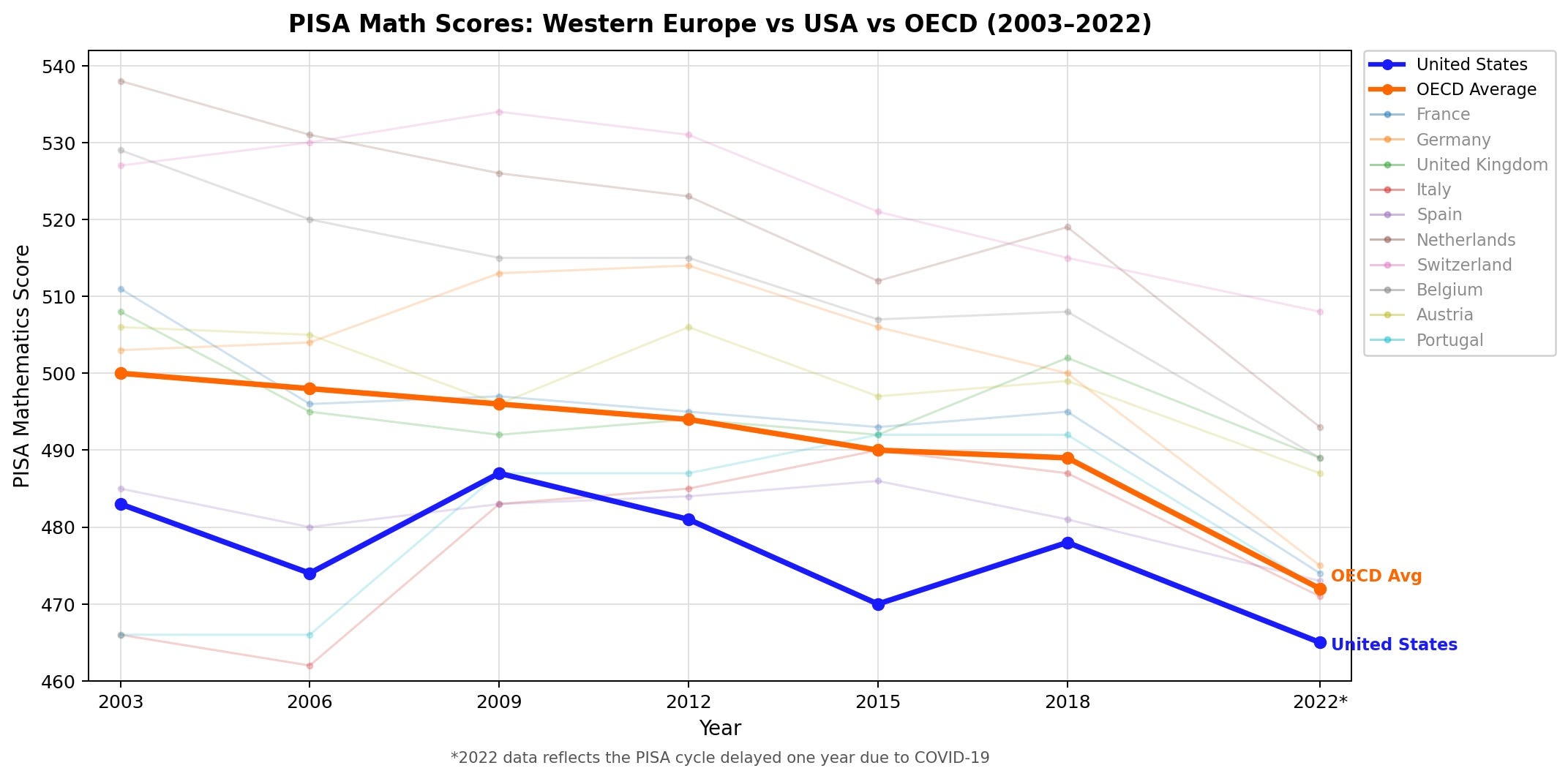
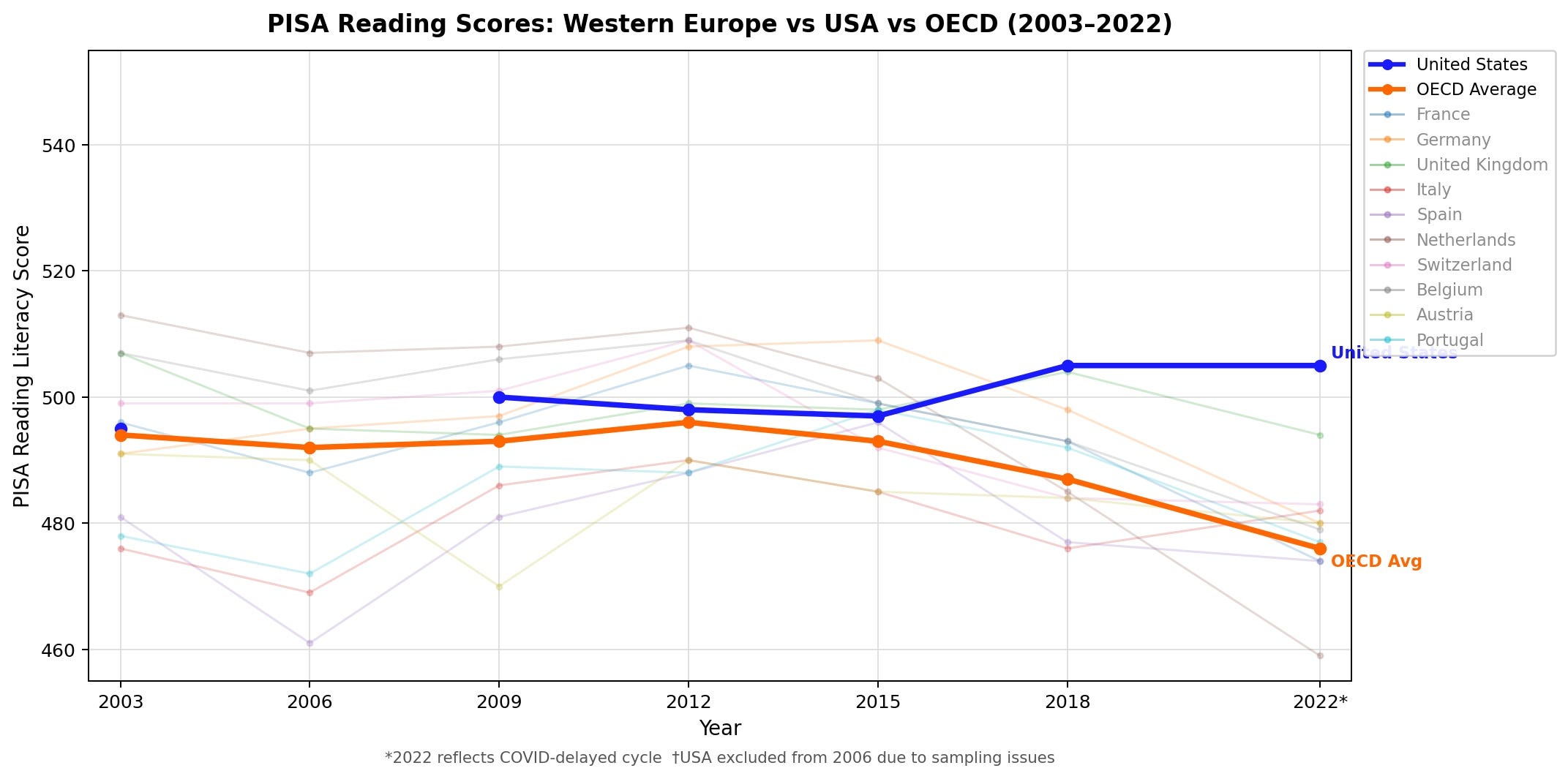
You’ll note (if you’re not a propagandist) that the American decline in math looks remarkably similar to declines across Western Europe and in the OECD average, and that we look quite good when it comes to the reading trends. Again, you simply are not going to read about this in The Atlantic or the Upshot. They don’t want to hear it; it contradicts the declinist narrative.
The same pattern holds for the NAEP, America’s gold standard assessment which is used to produce “the Nation’s Report Card.” The widespread and much-discussed post-COVID declines on the NAEP affected students in every state and every region of the country. These declines precisely parallel the global PISA declines! When the same pattern appears in Minnesota and Arizona, in Connecticut and Mississippi, and simultaneously in Germany, Norway, and New Zealand, the cause is not something specific to American educational policy. If anything, the uniform cross-national nature of the decline points toward shared forces - yes, I think most plausibly the explosion in adolescent smartphone and social media use, but no, I can’t prove it - rather than anything that individual nations school systems did or failed to do in that time period. It’s just powerfully difficult to look at these trends and say “This is an American problem,” let alone that it’s an American policy or American pedagogy problem.
None of the above should be taken to deny that there is a genuine crisis in some schools in the United States. But to put it very mildly, those problems are not evenly distributed across the country’s approximately 13,000 school districts. Instead, our real problems are heavily concentrated in a relatively small number of urban and rural outlier districts facing overlapping and severe sociological and economic challenges. The average parent on the average American suburban town just doesn’t have much to worry about when it comes to their kid’s school. But parents in concentrated poverty very much do.
Look at the NAEP’s Trial Urban District Assessment program, which provides district-level data for 26 large urban districts. That data makes the concentration of our problems quite visible.
Detroit’s public school district consistently scores at the very bottom of every large-city district tested. In 2022, Detroit’s average fourth-grade math score dropped to its lowest point since district-level scores were first released in 2009. On every metric, Detroit fell below every other large urban district tested. The reasons for this kind of concentrated failure are always many, complex, and tangled, but it simply isn’t credible to believe that policy and pedagogy play more of a role than the social and economic conditions of the city’s children. Detroit public school students have higher rates of child poverty and chronic absenteeism than almost any comparable cities. 66% of Detroit district students were chronically absent in 2023–24. 66%! That might be a school district problem, but it’s not something that can be blamed on individual schools, much less individual teachers. These are truly systemic problems, structural problems.
Cleveland’s performance is equally dire. In 2024, only 8% of Cleveland fourth graders scored at or above proficiency in reading. Only Detroit was worse, at 5%. The average Cleveland fourth grade reading score on the NAEP (184) was 30 points below the national average (214) and 35 points below those of Miami public schools, a city with lots of diversity but a significantly more stable economic situation.
Baltimore city public schools, despite being one of the highest-funded districts in the nation, consistently scores near the bottom in every NAEP category among the 26 largest districts tested.
So here’s my question. Do you really think that these schools perform that way because they have teachers unions, just like many of the highest-performing affluent suburban school districts do? That all of the teachers who work in these districts, including all the Ivy League do-gooders who show up with only a yardstick and a dream to fix the system, are just that lazy and untalented? That they just refuse to open the three-ring binder with the “GOOD PEDAGOGY” label on the cover? Detroit, Cleveland, Baltimore, et al do not share common district policies, or common union contracts, or common teaching philosophies and pedagogy. They do share catastrophic rates of child poverty and endemic crime and unemployment problems! They do share extreme segregation, population collapse, and decades of disinvestment in their surrounding communities! As I have done many times in the past, I’ll ask you to consider what would happen if these inner-city schools simply swapped student populations with the schools in the richest nearby suburban districts. I don’t think anyone doubts that the Detroit students would still struggle if they went to Bloomfield Hills schools, or that Bloomfield Hills students would excel in Detroit Schools, even if we disagree on the margins. Well, that should guide your perception of the overall state of education in this country.
For the record, schools in comparable cities (Miami, Charlotte, Austin…) which serve diverse and lower-income populations, but within more economically stable metropolitan environments, consistently outperform the crisis districts on NAEP despite often spending significantly less per pupil. The crisis is not inherent to large, diverse urban systems. It is specific to places with extreme and compounding disadvantage. Meanwhile, the OECD country profile notes something rarely reported: the math performance of U.S. students in the bottom international decile of socioeconomic status ranks 6th out of 64 comparable nations. To reiterate: even America’s most disadvantaged students perform remarkably well, when considered against the world’s most disadvantaged students! Thus it is not even true to say that our lowest performing outliers are uniquely bad. The problem is not that American schools fail poor kids at an unusual rate. The problem is that some of our communities are poor to a degree that is extreme even by international standards, and those communities schools bear the full weight of that concentrated hardship.
The academic outcomes of these areas of extreme concentrated poverty and dysfunction are indeed disturbing. But then, what’s disturbing is the concentrated poverty and dysfunction themselves, not the NAEP and state standardized test scores which are ultimately just evidence of these problems. That’s what’s disturbing, the inequality and hopelessness in the most economically powerful country in the world. Blaming the schools is like blaming thermometers for global warming. It’s malpractice.
In general, America’s public schools are judged by averages that obscure more than they reveal. A relatively small number of deeply struggling district, typically serving students facing concentrated poverty, unstable housing, underfunded services, and other compounding disadvantages, pull national performance measures downward and create a misleading impression that the system as a whole is failing. Those schools matter, their students matter, and both schools and students deserve attention, investment, and reform. But it’s an analytical mistake as well as political senseless to treat the most distressed outliers as representative of American public education in general.
For as long as I’ve been reading and writing and researching about education and education policy, pollsters and journalists have expressed puzzlement (that is to say, condescension) at a persistent finding in American public opinion surveys: Americans think their own community’s schools are fine, even as they believe American education in general is in crisis. The Gallup Poll on Public Attitudes Toward Public Schools has shown this gap consistently since 1985. In the 2025 survey, for instance, only 13% of respondents gave the nation’s public schools an A or B rating, down from 26% in 2004… while 43% gave their own community’s schools an A or B. Public school parents are even more positive about their own child’s specific school. (So not just the local schools or the district schools but their kid’s school.) More than three-quarters of public school parents give their child’s school an A or B. The percentage who are completely or somewhat satisfied with their child’s education has never dropped below 68% since Gallup began asking in 1999, even through the pandemic years. Parents like the schools their kids go to. They’ve been propagandized about supposedly failing public schools by Jon Chait et al for so long that they believe America’s public school system is a lost cause. But it simply isn’t true.
This gap, the gap in the belief “American schools are bad, but my kid’s school is good,” is typically explained as parents being irrational, as a form of cognitive bias, an embarrassing refusal for parents to accept just how bad everything is. People are too emotionally attached to their own schools to see them clearly! But in light of everything above, a simpler and better explanation is available: the parents are largely right and the national narrative is largely wrong. And honestly, what should you trust more, a parent’s take on their own kid’s school, or their attitude towards schools in general? Which do they have better information on? Which do they have real experience with? Gallup itself has acknowledged that parent views of the schools their kids go to are based on direct experience, whereas American views of public education more generally are based largely on what they see in the media. Parents in Naperville, Illinois or Falls Church, Virginia or Newton, Massachusetts, or Palo Alto, California, whose kids attend schools that consistently produce excellence - they’re not wrong when they shrug at national crisis coverage. Their local experience is accurate; it just isn’t representative of Detroit. But why would we base our perception of the system on the worst examples within it… unless, like the usual suspects, we’re actively looking to undermine public education?
The policy implication of this diagnosis is quite different from the policy implication of the generic “American schools are failing” narrative. If the problem was distributed evenly, the solution would indeed be systemic reform - new national curricula, universal testing regimes, wholesale reorganization. But that’s just not the reality. The problem is, in fact, remarkably concentrated, and in very predictable places, places that struggle from all manner of social ills, the most obvious and consistent and powerful of them being systemic poverty and community breakdown. Therefore the solutions have to be concentrated too: large-scale targeted intervention in the specific districts with the greatest disadvantage, not only or even primarily in the schools but instead concentrated in community investment, economic development, and poverty reduction that might actually make durable improvement possible. You see, friends, panic that is misattributed to the wrong cause produces wrong solutions, wrong solutions like “fire the teachers, close the schools, private school vouchers for everyone.” Precision, which every wonk should strive for, is where genuine reform begins.
Also...has anyone considered that US students don't give a shit about ungraded standardized tests and don't always try their hardest on them? As a teacher, I see this all the time on state tests. High school kids are pretty rational, ruthlessly so. Whatever test we're using to assess their baseline knowledge is one that many of them know has no bearing on their lives. I do not think this attitude is as prevalent in Asian countries
I was a little surprised how much the last post shifted into a discussion of unions and "woke ideology". Kind of ironic in a post about the propaganda cycle.
For what it's worth, your writing on this topic has meaningfully impacted our decision-making. We're about 12-18 months from needing to make the kindergarten decision and are very strongly leading toward the local public school vs continuing with our private preschool or going to the local Friends school. When we consider the low impact of nominal school quality on lifetime outcomes the fact that our neighborhood school is perfectly safe and pleasant (we know plenty of families that send their kids there and they're all happy), we just can't even close to justify the cost of going private. It seemed like there were a handful of other Philly parents in that last thread who made the same decision and were happy with their choice, too.
So all to say, thank you for laying the research out so clearly over the past few years - our family at least has found it very helpful