
There Are Many Different Ways to Commodify Black Culture
white praise is still the white gaze

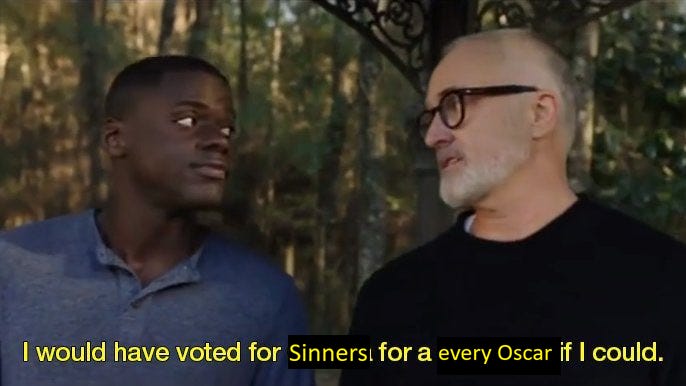
The Oscars are tomorrow night. This year’s races are considered unusually close, at least in many of the major categories. The ceremony is being widely represented as a showdown between Ryan Coogler’s Sinners and PT Anderson’s One Battle After Another, and as happens every year now the competition is being hung with all manner of dubious political importance.
My position is not and has never been that there’s no meaningful political content in these awards, and of course I want art from all cultures and identities to have an equal chance at being celebrated for their quality and ambition. But I also am aware that yelling about the Oscars is the kind of ritual that liberals engage in relentlessly, here in the 21st century, as a proxy for actual meaningful race politics. What are the tangible, material policy efforts that are being made to address Black poverty, Black disenfranchisement, Black struggle right now? No, really, list them. What are the Democrats attempting to do for Black people? It’s hard to name anything; the political establishment has largely given up. Coming up on six years on from the murder of George Floyd, we appear as a country to have agreed that we will only grapple with race and racism in the realm of symbol. So everybody yells about the Oscars in lieu of doing anything. That observation enrages some people, but it’s true, and I won’t stop saying it.
What I said about Sinners and One Battle After Another before still applies too, and had I seen Marty Supreme at the time I wrote that piece, I would have included it as well: the big awards show contenders this year are well made but shallow, entertaining but slight. They’re triumphs of craft, filled with the kinds of genre pleasures that bring people to the movie theater, but their much-ballyhooed political depths just aren’t there. I’m glad that movies that a lot of people saw in the theater are getting awards love, and to be clear I very much enjoyed both, but you can see in their reviews a certain sweaty, anxious desire to find layers of meaning that stubbornly never appear. People have long complained that watching Oscar movies is a matter of eating your vegetables, but I think the reality has flipped in the past decade - Oscar movies are now mostly uncomplicated entertainments that get larded with deeper meaning to justify handing them awards that at least ostensibly speak to a certain degree of complexity and ambition. Certainly Oppenheimer and Anora fit into this picture too. What can I say? It’s a populist world we’re living in.
One Battle After Another, or at least its reception, has been particularly glaring in this regard. The movie is often praised for its supposed attention to the immigration crisis, but Anderson cares so little about that crisis that we have no idea what happens to the migrants who are swept up in the crackdown in the sanctuary city that serves as one of the movie’s big set pieces. Many have identified Benicio del Toro’s Sensei as the film’s real heart, and it’s a delightful performance, but he’s dispatched by the movie in a profoundly abrupt way about two-thirds in. Anderson doesn’t really care about the politics underlying the story, and the film has no particular coherent position on immigration at all; that’s all place-setting for the family story he does care about. Which is fine! That’s what fiction is and does. The history of art made to satisfy political purposes is an ugly one, full of movies that put politics before cinema and so failed at both, as Nick Cave pointed out very eloquently recently. But awkward, grasping liberal attempts to celebrate the politics of OBAA - and in so doing make it not just a good move but a righteous one - are fundamentally built on a lie about what the movie cares about. The car chase pulls the movie away from all of its other concerns in a totalizing way, and that’s because the family story at its center is all it cares about. And the movie ultimately flubs its last ten minutes not because of politics but because it includes the pointless Colonel Lockjaw scene and because it has no idea how it ultimately feels about Perfidia Beverly Hills. Movie problems, not politics problems.
Sinners, meanwhile, is a decent movie about race and cultural appropriation but an exceptional one about fucking up vampires in the Jim Crow South. The movie is a triumph of atmosphere, set design, kinetic filmmaking, and tons of small characters that resonate because the actors find grace notes in little bits of screentime. You can practically feel the sweat in that building, and part of what makes the movie so effective is the switch from the heat of music and booze and good times to the heat of fear and violence. It does take a little too long to get there, though, and part of the dithering quality of the opening sections stems from the movie’s self-consciousness about its sociocultural valences. Of course there’s all manner of political dimensions in a movie set in a period of apartheid; it’s just that those dimensions are the least effective, least interesting elements of the movie. I like Hailee Steinfeld and I don’t think she gives a bad performance, but the movie labors so hard to convey the complexities of white women’s desire in the Deep South that it drags and labors when she’s onscreen, and that’s a real shame in a movie that’s so remarkably propulsive.
The insistence on inserting political importance into every piece of Black art leads directly to the worst scene in Sinners. After a rollicking good time portraying the protagonists hunkered down in the bar, defending themselves against waves of the undead, we’re given a scene where the surviving Michael B. Jordan gets into an explosive shootout with some Klan members. The scene feels incredibly awkward, to me; we’ve just gotten this long, sharp, effortlessly fun action-horror movie, filled with balletic and visceral violence, and then we have a tacked-on coda where the audience gets to see some Klan guys get killed. It feels obligatory and unfocused, but of course it does. Sinners is a vampire movie! A lot of people have described the scene as cathartic, but, like… the movie is the catharsis. The story is the catharsis. The thing itself is the thing itself and the thing itself is the catharsis. Were it not, no one would have gone to see it.
One Battle After Another is a touching family story that opens with a truly energizing portrayal of armed resistance to fascism and which does not quite know how it should end. (With Bob and Willa embracing on the highway, was the correct answer.) Sinners is a sterling example of an elevated genre movie, a remarkably well-crafted action-horror movie that gets bogged down in its assumed responsibility to be About Race. To be clear, that responsibility is not something the movie has taken on itself, but rather is part of the burden of American racism. Still, the fact remains that the movie is most effective when it’s least self-conscious, when it’s just being scary and fun. I think Sinners is better than its most obvious antecedent, From Dusk Til Dawn, which suffers from terrible pacing issues and a lot of tonal confusion. But Sinners is not a deeper or more serious movie than From Dusk Til Dawn, and the assumption that is must be is, again, a vestige of America’s endless fandango with its own racial anxieties.
Of course, the difference in my discussing Sinners this way, when compared to discussing One Battle After Another in the exact same way, is that OBAA is a movie with some Black characters and some Hispanic characters but Sinners is unquestionably a Black movie. As such it has been hung with all of the baggage that falls on Black movies during awards season, including the sweaty-palmed efforts of many white liberals to show proper respect and, in so doing, show off their enlightened racial attitudes. I have in the past invoked the white guys with glasses in the late 2000s who would accost you at bars and parties to regale you with their take on just how great The Wire was; The Wire’s greatness is unquestioned, but pretty quickly you got the impression that these guys were less interested in saying something about The Wire and much more interested in telling you something about themselves, about how they were The Right Kind of White Guy. You can see this phenomenon with certain overwrought hymns written about Kendrick Lamar and various other symbols of Black artistic excellence that have been given totemic force by white people. And, I would argue, that has obviously become the case with Sinners. Is that fair to Black art and Black artists, the way white praise has a way of inviting suspicions about its purpose and sincerity, given the performative requirements of 21st-century elite culture? Of course not. It’s deeply unfair. It’s a version of, or a corollary to, W.E.B. Dubois’s concept of double consciousness - that which is Black is never allowed to just be, it must also see itself being, in a way that must be more awkward and tiring than I can imagine. But the dynamic I’m describing exists, and people who get theatrically offended by this essay will be playing pretend.
What’s interesting with Sinners is that it’s a movie about white exploitation of Black culture that’s celebrated by a white critical establishment that, in treating it as a talismanic statement about race, is arguable guilty of engaging in its own kind of exploitation. I mean, right? Isn’t White Guy Who Won’t Shut the Fuck Up About How Sinners is a Towering Masterpiece For All Times himself being a bit vampiric? Nate Jones of Vulture describes Sinners as “a pulpy action-horror flick that uses blues-loving vampires as a metaphor for the commodification of Black culture.” This is a standard reading of what’s happening in the movie - the vampires are leeching off of the blood of Black people in the same way white people leech off of Black culture. I find this a little confused, given that the music played by the Irish vampires is so explicitly not an example of “cultural appropriation” in the way often said of rock and roll. But OK. Is the endless effort of educated urban white liberals to associate themselves with Black art and Black culture not itself a commodification of Black culture, strip-mining Blackness for a kind of social cachet in their competitive elite world?
All of this, again, is unfair to the actual art and the actual artists. (But then I’m not the one who created the conditions I’m describing, am I?) The relentless, cycle-after-cycle campaign demanding that awards shows recognize Black artists has produced an ironic and damaging side effect: it has made genuine recognition feel like compliance. When an industry spends months loudly insisting that a particular film, album, or performance must be nominated, that nomination, if it comes, arrives pre-poisoned. The public, having watched the pressure campaign unfold, cannot easily separate the merit of the work from the politics of the moment. Did the Academy honor that performance because it was extraordinary, or because the conversation became too loud to ignore? The discourse, however well-intentioned, reframes the act of rewarding Black art from a natural response to excellence into an obligation fulfilled, homework turned in. It transforms artists into causes. That the usual suspects would lambaste anyone who dared to say all of this out loud doesn’t change the fact that there really is an inevitable impression, engendered among the unwashed masses, that the fix is in. And the cruelest part is that the sense of obligation generated by #OscarsSoWhite talk does all of this to the very artists it claims to champion, casting a shadow of institutional charity over achievements that needed no advocacy at all.
The preceding paragraph is the sort of thing that people get really mad about, but I have no idea why. Of course, when you spend months pre-lamenting the inevitable awards-season disrespect of a movie like Sinners, the respect that it ultimately receives will be colored by an assumption of illegitimacy among many. Whether that’s fair or not is not a meaningful question; of course that’s what happens. You already know it’s what happens. Don’t yell at me about it.
The only way out of this is to try and escape the thick brambles of meta-discourse and arguments-about-arguments and endlessly-replicating fractal complexity we’ve developed in our racial arguments. Again, we are living in a uniquely immaterial period of American racial politics; it often feels to me that we’re incredibly far from a focus on putting food in the bellies of Black children, building safe and nurturing environments for Black lives, and creating opportunities for genuine empowerment within the reach of Black generations. I don’t intend to dismiss the reality or importance of the history of Black people not receiving due credit or payment for their cultural contributions, but I do confess that such concerns seem remote when I drive through New Haven and see impoverished Black children living in crumbling lead and asbestos-filled houses. But it’s even worse than that, because the debate about Sinners that we’re going to be having after the Oscars won’t even be the debate about cultural appropriation itself but rather a game of 11th-dimensional chess about the white establishment’s attitudes towards a Black movie about white people’s exploitation of Black art and culture…. It’s a hall of mirrors, all of it. It’s a white woman smiling to herself reading White Fragility on the subway because she thinks the point is that other white people are fragile. It’s all a mess.
I’m not suggesting that any of it is easy. I don’t know what the best program for a material racial equality movement might be, nor do I know how to build the coalition necessary to implement one. But I am naive enough to say, you know, maybe the enlightened path really is to let a movie just be a movie?
Yes, the standard reading that Sinners is about cultural appropriation does not hold because the “white” vampires are explicitly coded as Irish. Unless we think Ryan Coogler is so dumb that he doesn’t understand culture or history, this means the vampires are…
-Of a culture that is richly musical
-Of a culture whose musical tradition is not connected to Black R&B, emerging separately from it
-Of a culture that’s historically been marginalized and even colonized
So yeah, it ain’t about white cultural appropriation.
And yes the KKK scene is horrible
The moment art is required to be a vehicle for politics, morality, or social instruction, its imaginative power drains away. Art matters precisely because it is not reducible to a message. It is its own thing. Sometimes, two paths in a wood are just that and a poem about them is just about taking a walk with a friend.