
The Luol Deng Law
it's better to win than lose, and it's better to have good players than bad players


The NBA has been dealing with controversy over rampant and shameless tanking lately, and it’s easy to see why. For those who are unaware, teams tank (that is, lose intentionally) because doing so improves their odds in the draft lottery, which determines which players they can select in each year’s amateur draft. Draft position is important in all major professional sports leagues, but it’s uniquely so in the NBA, because there’s only five players on the floor for a give team at any one time and the league is more star-driven than any other sport; it’s widely understood that winning a championship is (almost) impossible if you don’t have a top-ten player, preferably a top-five player. So a lot of teams are openly trying to lose, and they’re doing so more brazenly and earlier and earlier in the season as time goes on. Which, you know, is not a great look.
For example. Recently the Utah Jazz, one of the most fervently tanking teams in the league, played a game against the Orlando Magic. They were winning at the half, then proceeded to bench their three best players in the second half, turning a very winnable game into a loss. To make it even more obvious, the Magic had a three point lead in the last moments of the game, the Jazz had possession and a timeout, and did not use that timeout to set up a potential game-tying three-pointer. That very same day, the Washington Wizards held out every decent player on their roster in order to lose a game against the dreadful Brooklyn Nets, who had lost a game by 50 not that long before. All of this happened before this weekend’s All-Star break, which is traditionally thought of as the halfway point in the season and where the regular season gets serious. It’s bad out there.
Tanking is bad and wrong and wrecks sports and destroys fan trust, and it intersects with another troubling problem for the league, which is “load management,” which means sitting players who are healthy enough to play in order to limit the wear and tear on their bodies. The Los Angeles Lakers certainly aren’t tanking, but that fact would be of little comfort to a family of five that bought tickets well in advance to see them play a recent game against the hometown San Antonio Spurs. Decent seats, parking, food, and a souvenir for each of the kids could easily exceed $1,000 for three hours of entertainment, even in a smaller market like San Antonio. Now imagine being the dad of that family and telling the kids when you get there that the Lakers were holding out their five best players, including consensus top-five player Luka Doncic and LeBron James, who’s still probably the most famous active athlete in the country. You’re training those kids to think that the NBA doesn’t give a shit about them, and this is in a context where traditional team sports are fighting for their lives to attract the interest of kids who are addicted to Minecraft and Roblox. The long-term impact of this stuff is clear, even in a context where ratings have rebounded.
Tanking is a specific manifestation of a more general attitude that’s gripped the NBA specifically and sports generally in the past decade or two, thanks in large part to the influence of analytics: the notion that it’s better to lose a ton than to win some, better to be a terrible team than to be one that’s good enough to make the playoffs and maybe win a series or two but not good enough to win a title. It’s an all-or-nothing attitude towards team sports, and it breaks the basic logic of athletics - the assumption that it’s better to win than to lose.
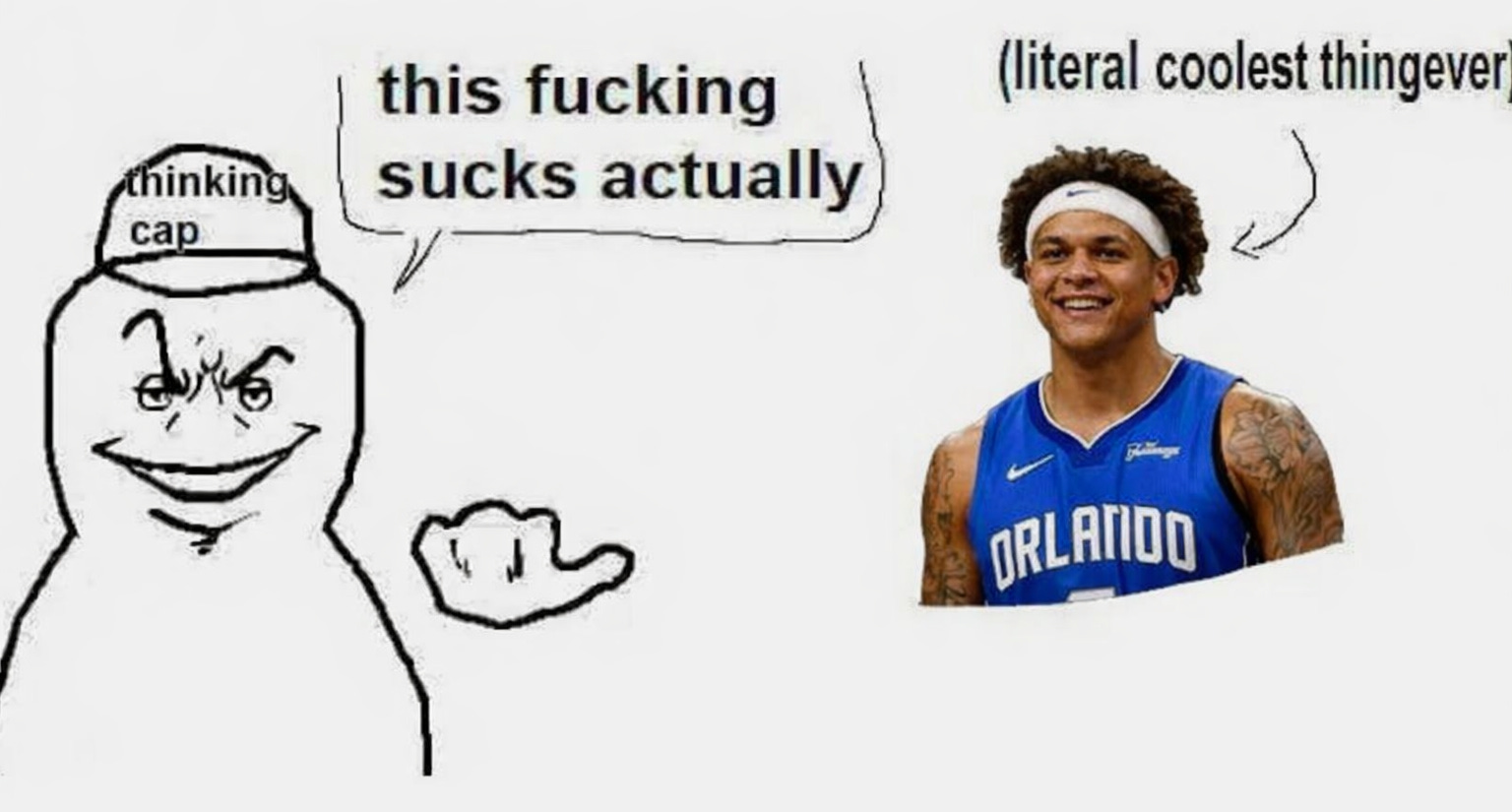
So consider this discussion on the r/BillSimmons subreddit, which itself refers to a Twitter conversation about players who are good but not good enough to take a team to a championship and thus (the thinking goes) should not receive large contracts or be acquired with important team resources. To be clear, I’m picking this thread more or less at random and using it as a stand-in for the broader NBA conversation going on in podcasts and on Twitter and Reddit etc. The thread points to Paolo Banchero, a forward for the Magic who not that long ago was considered one of the brightest young stars in the league but who has recently seen his perceived value drop like a stone. To be clear, Banchero is a great player who I find uniquely enjoyable to watch, but he’s not a particularly efficient scorer, which makes him the target of the still-influential NBA snob demographic. The perceived scenario is that Banchero’s not good enough to get the Magic to a title, but his contract cripples their financial flexibility, while Magic fans are (understandably) possessive of him and would be upset if the team traded him. Jeremias Engelmann, creator of Real Plus Minus metric and something of an influence in this era of “actually it’s cool and good when NBA teams suck,” calls these players Quagmires - good enough to win games, not good enough to win titles, will suck up a lot of your salary cap space, leaves you in limbo.
I think this attitude is really destructive, and to demonstrate why, I want to talk about what it’s been like to be a 21st-century Chicago Bulls fan. The Michael Jordan dynasty obviously thrilled me, and in fact kind of bent my perception of what it’s like to be a sports fan, but I was a child then. Since I became a legal adult, the Bulls have not sniffed another championship. What we’ve had has been an immediate post-Jordan period that featured some of the most atrocious basketball you’ve ever seen; an era with a young, driven, winning team that made the playoffs and were a lot of fun and had zero chance of playing for a title; the tragedy of the Derrick Rose era; and a subsequent period of the most listless, directionless, emotionally-deadening teams you can imagine. I want to focus on that second era, the period with a young competitive team led by Luol Deng, Ben Gordon, and Kirk Hinrich, a team that made the playoffs three straight years, played some enjoyable competitive games against the dominant “Big Three” Miami Heat, saw Gordon win Six Man of the Year, and never fooled a single basketball analyst or fan into thinking that they were a championship contender. And what drives me insane is that the current “meta” would have you believe that the fun, spunky, winning Deng-Gordon-Hinrich era was worse than when the team was winning 17 games, under the theory that it’s better to bottom out than to be good but not good enough. That logic drives me crazy. It’s sports nihilism.
First, let’s remember some Bulls from the immediate post-Jordan era.
Bill Wennington
Dickey Simpkins
Kornél Dávid aka Dávid Kornél
Dragan Tarlac (yes that is the name of an actual former NBA player)
Fred Hoiberg
Charles Oakley (in his 17th season)
Ronald Dupree
Norman Richardson (team the following season: Scavolini Pesaro)
Dalibor Bagarić
Marcus Fizer (ugh)
Jake Voskuhl
Tyson Chandler (when he sucked)
Eddie Curry (who always sucked)
Khalid el-Amin
Jannero Pargo
There were some rough, rough years there. Over a five-year period, the Bulls averaged a record of 21-61, and that’s not even including the 13 wins of the strike-shortened 1999 season. Moving on from the Jordan-Pippen-Jackson era was always going to be difficult, but also the team was run by the basketball terrorist duo of GM Jerry Krause and owner Jerry Reinsdorf, both of whom hated winning, Chicago Bulls fans, and joy itself. We had Jamal Crawford for a bit, but he wasn’t yet what he became; we had Elton Brand, but in his in-over-his-head-first-overall-pick-franchise-savior era, not 25-and-10-career-renaissance LA Clippers era; we had Jalen Rose going from being a feisty second option on a championship-contending Indiana Pacers team to being misused and overwhelmed as an alpha on the Bulls. There was some talent, but there was zero winning, and the now largely-forgotten loss of once-in-a-generation point guard prospect Jay Williams cast a pall over everything. There was a lot of gallows humor in the immediate post-Jordan season - “Hey, silver lining, Toni Kukoc unleashed!” - but everyone knew that we were in for some pain. We just didn’t know how much and for how long. That Deng-Gordon-Heinrich period was such a salve after all those awful, misshapen teams; it was so fun to root for those guys. And the idea that it would have been better to lose 50+ games again rather than field a competitive NBA team, which is now inescapable in basketball discourse, is anathema to me.
Here is my Luol Deng Law.
Winning is better than losing, and having good players is better than having bad players
Sounds simple! Indeed, to many of you, it might sound too obvious to be worth saying. But consider that Twitter thread and the Reddit conversation about it. The original post, from Twitter user bluelemxnade, says
Paolo Theory is the idea that drafting a good-not-great player like a fringe all-star with a top pick could be more detrimental than drafting a bust because said players are disproportionately likely to be overcommitted to by their franchises in team building/cap allocation
There you have it: you’d rather have a bust than a star who can’t get you a trophy. You’d rather have Marcus Fizer, the most depressing draft pick in that whole sad run, than Paolo Banchero. You’d rather go 20-62 than 46-36. You’d rather suck shit than be decent. A commenter on the Reddit thread says, “good thought experiment - would the Pelicans have been better off if Zion was a Kwame Brown-like bust? hard to tell.” Zion Williamson is a uniquely depressing figure, a transcendently talented prospect who has struggled with his weight and innumerable injuries and who genuinely seems not to care about basketball. (This accusation is made all the time, in pro sports, and is almost never true, but with Zion I’m willing to be convinced.) Even so - you’d rather he have been Michael Olowokandi? Anthony Bennett? Darko Miličić? It’s just hard for me to fathom that. And if it’s correct in the strictest practical sense, then that indicates a league with badly broken incentives that needs to follow major league baseball in making major changes to save fan interest and rescue the game.
I name this law after Luol Deng because a) the Bulls are my team and b) he was a highly-drafted1 player who was good enough to elevate a team but not good enough to make it a serious contender and c) he played for teams that won a bunch of games, made the playoffs, thrilled the fans, and never had any real shot of making or winning an NBA Finals. Perhaps he’s an imperfect avatar here, but I don’t care. He was a fun, competitive Swiss army knife of a player who always brought maximum effort for the Bulls, a fan favorite, a winner, and a guy who topped out at making a couple of All-Star rosters as an end-of-bench reserve and was never going to be the best guy on a championship team.
Deng slipping to the seventh pick in the draft would have seemed like a minor upset during his one and only college season at Duke, where he lost in the finals of the NCAA tournament to Gordon’s UConn Huskies team. Deng was considered a plus-plus athlete at that point, with tantalizing upside; his stock was somewhat dragged down by the fact that he was a bit of a tweener. His career, honestly, was a little unfortunate in that he would have potentially fit much better in the NBA that emerged in the years following his prime; he played long enough to see a little of the pace-and-space, three-point-dominant modern NBA game. He only shot 33% from three for his career, and on about two or three attempts a game, but had he been born five years later he might have been developed into a quintessential 3-and-D guy. Mostly, I pick Deng here because he is the Bull I most associate with those fun, winning Scott Skiles Bulls teams, the ones before the massive talent injection of Rose and Joakim Noah and Taj Gibson, the ones who could never, ever have beaten the LeBron Heat. He was never a max guy like Banchero, but he was a good player, the kind you should want on your team, and since he played on teams that never came close to winning a ring, he and those teams are considered a special kind of failure by many modern NBA analysts.
There are a million suggestions for how to fix the NBA, and dedicated basketball fans now tend to roll their eyes at the discourse. One of the best suggestions is one that will never happen: shortening the season, perhaps from the current 82 games to 66. Bill Simmons has been making this case for many years. Players would have fewer injuries, there would be much less reason to rest healthy stars, and every game would matter that much more. The trouble is that the league makes money based on how many games fans can attend and how many can be broadcast, so that’s almost certainly not happening. Getting rid of pick protections is much more feasible and would be a good start. Some have contemplated eliminating the amateur draft altogether and with it any direct incentive to lose; in such a world, rookies would be free agents like any other and available to sign with whoever they want. I admit that this idea is intriguing, but it’s genuinely hard for me to imagine how lower-revenue, smaller-market teams like the Utah Jazz or Minnesota Timberwolves could put together championship teams under those conditions. It’s hard enough for them to do so now. One way or another, something has to change.
Aside from structural changes, I think we just need to let go of this “championship or bust” mindset. The big four sports leagues (NBA, NFL, MLB, NHL) all have thirty or thirty-two teams. Even if we never had any dynasties - my preference, personally - the zero-sum, championship-or-nothing attitude would leave us with vastly more failure than success. I don’t think it’s healthy. I much preferred, for example, the attitude many baseball fans held when I was a kid, where their team could have a winning record, finish well short of the playoffs, and still be seen as having a successful season.
I am of course being a little tongue in cheek with my Luol Deng Law; no one really needs to be told that winning more than less should be the point and that teams should want good-but-not-great players instead of busts. No one should have to articulate a law that says that it’s better for an NBA team to win 45 games than 20. But that idea is very much contested in modern basketball analysis, and it’s left us in this place where the regular season becomes more and more of an afterthought and where teams don’t even appear to be interested in chasing true greatness before the postseason begins. (I believe that, during their record-setting 73-win season, Steph Curry, Klay Thompson, and Draymond Green played 79, 80, and 81 games out of 82, respectively - unthinkable in today’s NBA.) Winning should always be its own logic, but this “Paolo Theory” business is an explicit articulation of the opposite perspective, and it’s harder and harder to avoid that idea, an idea that ruins sports. It was better to watch Deng and Gordon and Hinrich grit out more than 40 but fewer than 50 wins, make the playoffs, and lose to more talented teams than to watch the shambolic post-Jordan Bulls make a mockery of competitive basketball. That attitude should never be controversial.
By the Phoenix Suns, technically, at the 7th overall pick, but he was trade to Chicago as part of a draft-day trade and never played for Phoenix
I'm glad to see you write this article. I HATE that fans endorse tanking.
1. It *guarantees* miserable seasons, but it does NOT guarantee a championship. Did the 'process' bring the 76ers a Championship? Have the Nationals turned their post championship tank into a winning season yet? Does the future look bright for the Rockies?
2. Every team but 1 will not win the championship. It's a really, really dumb metric to only judge a season by whether you end up on top. As a baseball fan, I get 162 games to watch the STL Cardinals and every time they win, I'm happy. I would rather be happy 83 times than 61!
3. Making it to the playoffs means I get more chances to be happy when they win. The Cardinals got swept in the 2019 NLCS but the division series win over the braves had 3 great wins in it. That's 3 more times I was happy.
4. It's immoral. The purpose of games is to win. To do otherwise is wrong
5. It's undeniably connected to a financial component. The owner is telling the fans it's so they can win down the road, but in the meantime, please accept a WAY shittier product and (usually) we're not lowering ticket prices thanks for still attending.
Could not agree more about the soul-deadening effect of the championship-or-bust mindset, which is why I hate hate HATE what's happening with college football and the playoff--and I say this as a Michigan fan, a team that recently won the playoff and can reasonably expect to be a frequent playoff participant going forward. I'm old enough to remember when winning the Rose Bowl, or even just a high-profile bowl game against a good opponent, was an exciting and satisfying end to the season, and the team that finished on top of the polls was still called the "mythical national champion." That was much more fun than the mini-NFL monstrosity that's being constructed now.