
The Force Field

You may groan! You may say, “Again?” You may roll your eyes. But I’m going to talk about this one more time, and then I think I’m done. But I’ve always been right about all of this, and it needs to be said.
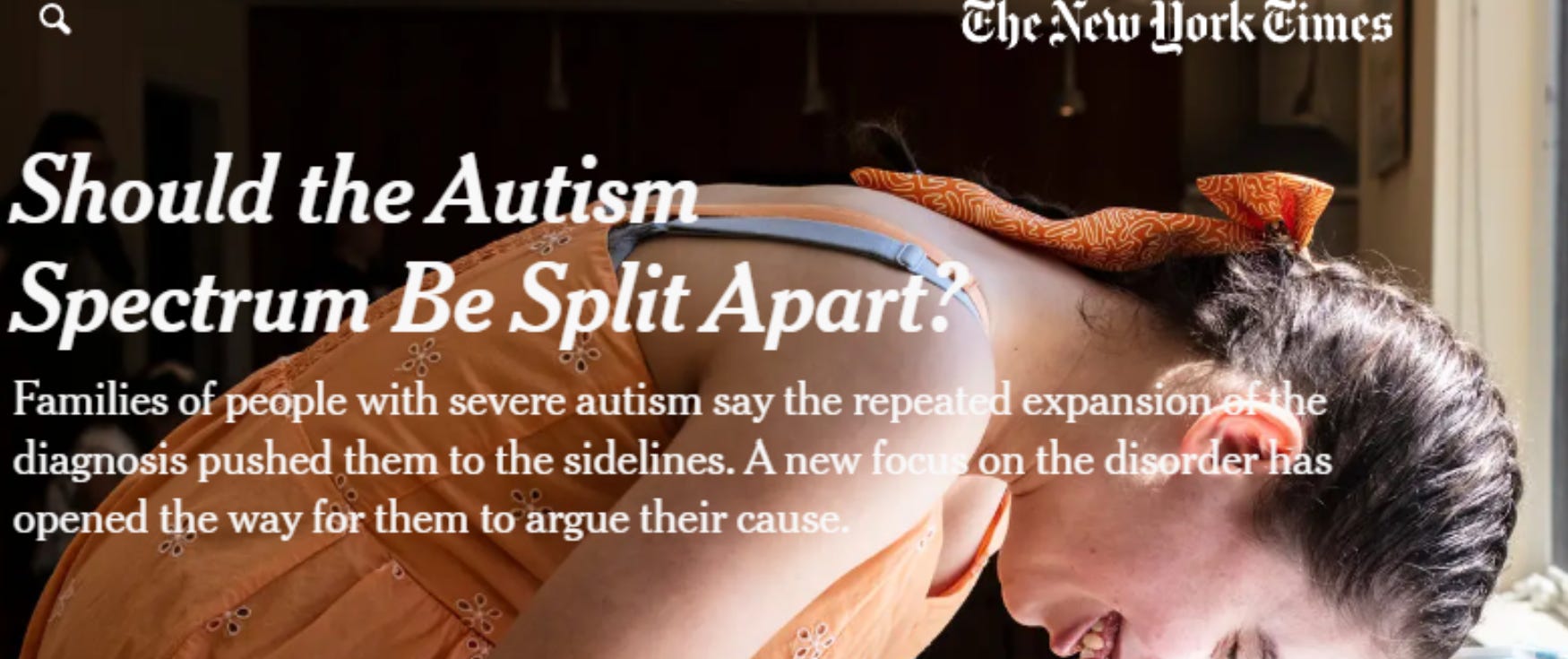
The Times has once again parachuted into a conversation that has been going on for decades, planted its flag, and declared itself the discoverer of new territory. Yesterday they published a piece on autism, neurodiversity, RFK Jr., and whether the autism spectrum should be split up - split back up, that is, to reflect on the massive differences between those with profound autism and those for whom “neurodiversity” is mostly a social badge, a tidbit to be displayed on a Bumble profile. (The answer is yes, of course the spectrum should be split up again, for reasons I’ve written about at great length.) That issue, unusually raw, will bubble on, as it sits at a genuinely uncomfortable intersection of liberal identity norms, online culture, and the genuinely debilitating reality of severe autism. In terms of progressive discourse rules, the plight of the severely autistic and their loved ones is truly a problem from hell: those rules insist that you can’t ever question someone’s diagnosis, no matter how dubious; they demand that you acquiesce to claims made from a position of disability, no matter if they cut directly against the claims made by others from their own position of disability; they have long ago lost sight of any distinction between identity and disorder; and they’re governed by a selective and incoherent vision of standpoint theory that insists that only the autistic can speak out about autism - which perversely empowers the least-afflicted and silences the interests of the most-afflicted, as the most-afflicted literally cannot speak for themselves. You know my rap on all this.
In meta terms, though? This tendency of the NYT to helicopter in to long-simmering debates and bless them with the paper’s attention, and in so doing anoint those debates as worthy of attention by grownups, is only the latest example in an old, ugly dynamic. The little people in independent media ask difficult questions and engage in rancorous debates and stick their necks out in the service of ideas, which is what the media is supposed to do. Then, once the heavy lifting is done, the Grey Lady squats down on that issue and says “this is mine now.” The paper’s consolidation of both prestige and financial security - its status as both far and away the most prestigious publication in world media and maybe literally the only financially healthy newspaper left in the United States - has all manner of pernicious, perverse consequences in an industry that can only function when people within it are engaged in debates with real stakes and real hurt feelings. Again, nothing you haven’t already heard from me. But when there is only one endpoint for the ambitious to aspire to, there’s an inherent and unavoidable silence about that endpoint’s myriad failings. The Times, for its part, has walled off criticism within its own pages with its “we don’t do media criticism” rule, a profoundly self-interested and cynical policy that helps them evade ever having to justify their own widely-criticized practices. And for all manner of complex reasons, the broader world of stodgy old media, dying though it may be, still holds all the cards when it comes to defining debates that involve institutional stakeholders, as the debate about autism’s future certainly does.
I don’t begrudge any writer for wanting to weigh in on these issues - God knows they matter and need more attention - but what’s striking about the Times’s coverage is how effortlessly it erases the long history of people already fighting these battles, and the richness of the debate that preceded them. Whole archives of independent writing, analysis, and advocacy disappear when the Paper of Record decides that a question now exists. Until then, the issue is marginal, unserious, relegated to the sidelines; afterward, i’s real, it’s official, it’s legitimate… and therefore too important to be left up to those of us in the cheap seats. This is the paradox, you see; no issue that independent media concerns itself with can be considered truly serious, and no issue that they (eventually) deign to be truly serious is something that they trust the independent media to engage with responsibly. Quite a little trap, there. And when the grownups in the room walk in, we’re meant to feel blessed by their presence, happy to have our pet issues taken seriously. Everyone else who’s been in the trenches for years is supposed to be grateful for their newfound recognition.
Yes, of course I’m talking me and this issue, though not just me and not just this issue. I have written again and again about what I’ve called the gentrification of disability - the way elite society rebrands and redeploys disability discourse to serve the interests of the least-afflicted, smoothing off the edges of punishing disorders, ignoring vast disparities in terms of who can gather attention and who can’t, and in general turning discourses that were centered on illness, disease, disorder, and dysfunction into celebratory cliques dominated by the educated and the affluent. The NYT’s belated entry into the autism conversation is encouraging, to the degree that it brings more attention to the small chorus of voices who have been pushing back against the takeover of autism by the barely-afflicted. And probably I should leave it at that. But, you know… the piece is just not that good. Forgive me the vanity, but I’ve engaged this issue with more depth, more rigor, and more honesty than what they published yesterday. And I’m hardly alone. The blogosphere, the independent press, the lived experiences of autistic writers and thinkers… all of these have been rich with insight for years. But the Times ignores that because the mandate of the industry is not to reward quality, or originality, or urgency. It’s to anoint the right voices, the voices with the proper friends and degrees and institutional backing. It’s to tell the world what counts.
I’m just some shmuck with opinions, right, and I don’t expect anyone to touch base with me or my ideas; I certainly no better than to ever expect the attention of the august New York Times. That’s not the problem. The problem is that, structurally, essentially no one who is not already a paid-up member of the media kaffeeklatsch ever could break through the filter bubble. And the evidence I have at hand says that ideas like mine matter. Since I published that first post, I’ve received more than 400 emails from autistic people, the family members and caregivers of severely autistic people, researchers, teachers, doctors, and various other stakeholders in this issue, thanking me for what I had to say and sharing their own stories. And they didn’t reach out to me for no reason. That kind of passionate interest and organic viral spread should be pretty much all that matters; in the media business as it currently exists, it doesn’t matter at all.
I recognize that this may sound like sour grapes. I recognize that, to a degree, it is sour grapes. It is irritating, I admit, to pour years into thinking and writing about disability politics, only to watch as the establishment press wanders in and acts as if they’ve just invented the wheel. But the real issue is not my ego. The issue is a media ecosystem in which the same small circle of insiders can decide who matters and who doesn’t. After all, there are many people who have quietly burned with resentment as the disability activist class has rewritten what it means to be sick, aggressively claiming all of the discursive territory they can and threatening anyone who pushes back with their particularly ugly brand of vicious social and professional discipline. That initial wave of people who took on a great deal of hassle and risk will be marginalized in this conversation moving forward, in favor of whoever the Times and a few dozen talentless apparatchiks at various big-time publications deigns to anoint as worthy of listening to. You might notice, for example, that there’s no reference in the NYT piece to Dr. Amy Lutz, an academic who has studied these issues professionally for many years, the mother of a severely autistic child, and someone who has endured exactly the kind of bullshit you’d imagine someone in academia would endure when they defy the disability studies people in this way. It’s absurd that she’s not in there.
The poohbahs who lord over this crumbling industry can ignore the dozens of writers who have said these things earlier and said them better until the moment they choose to care, at which point everyone else’s labor and clarity becomes invisible. This isn’t just about credit, although credit matters. It’s about the way the Times and its peers reproduce hierarchy: they colonize conversations that were already alive, flatten the complexity, and hand the microphone to the people who least need another microphone. They do it all while pretending that what they’re offering is “the conversation,” when in reality it’s the establishment’s sanitized, corporatized, filtered-for-the-sensibilities-of-affluent-liberals version of the conversation. And the sad fact of the matter is that, some 20+ years after the blogging revolution, in a world filled with highly-read and influential crowdfunded newsletters, they still have the power to set the boundaries of the conversation, to a truly discouraging degree.
You’d think that as independent media ascends in the face of the cratering economics of traditional media, this stranglehold on defining what’s important would loosen. After all, the financial decline of traditional media is obvious, and the cracks in their authority are there for anyone to see. But perversely, the opposite has happened: the more the industry collapses, the more jealously they guard what power remains, tightening their grip on legitimacy even as their actual readership dwindles. The breadth of voices that the establishment media will publish, the variety of ideas that they’ll bless with their imprimatur, their willingness to risk controversy to say things that are provocative and true - all of these are at their lowest ebb in the 20 years I’ve been in this business. Instead of recognizing that the world has changed and that the conversation belongs to everyone now, the powers that be treat their waning influence as a precious inheritance to be defended at all costs, planting their flag on debates that long predate their interest and insisting that they still gets to decide who matters.
I first started writing for a public audience in 2008. Back then, we were still living in George Bush’s America, even though he had effectively become a lame duck president following the midterm election of 2006. The internet had already done a great deal to “disrupt” media, and the great purge of local newspapers was underway, but it wasn’t yet clear that the business was fundamentally broken; Facebook and Google had not yet shut off the traffic spigots, and the absurd nine-figure valuations for outfits like Buzzfeed and Vice were in the future, not the past. The collective workforce of the media was only just starting to coalesce around Twitter as the politburo of the industry. The traditional blogosphere was considered passé, as many of the most prominent old-school bloggers had been absorbed into the establishment media, but it was still unremarkable for a perfectly mainstream newspapers or magazines to quote Hilzoy or Digby or Instapundit. And nobody was a bigger deal, in terms of audience or influence, than Glenn Greenwald.
Greenwald started writing for Salon (then a serious and respected online publication) in 2007 and quickly became a star. A natural fit for an era where the blog style of lengthy prosecutions was still prominent, Glenn wielded immense influence as one of the sharpest and most relentless critics of the war on terror, the surveillance state, and the bipartisan consensus enabling both. His work, widely read and deeply feared by political elites, shaped the terms of debate in ways few independent writers could claim. A former litigator, he was a natural fit for an America whose corrupt and incompetent executive presided over a disastrous war of choice, an unforgivable failure to respond to a natural disaster, and an economy on the brink of total collapse. Yet for all that reach, Greenwald was curiously siloed within the broader media conversation. While there was plenty of engagement within his work on the level of blogs and independent political sites, the mainstream newspapers and magazines that were still dominant at the time largely refused to even acknowledge his existence. Glenn was loathed within mainstream media circles, treated as shrill, unserious, and combative, cordoned off from polite company despite his obvious impact, a pariah whose very success made his peers more determined to silo him.
Greenwald was in that unfortunate space where his work was so influential that it was frequently absurd for mainstream voices to write about issues that he was deeply involved with without mentioning him - but still, they would often not mention him. This led to funny business like magazine and newspaper writers linking and quoting pieces in other blogs that were direct responses to things Greenwald had written… without mentioning Greenwald at all. (Yes, I’ve been on the receiving end of this behavior myself, including within the past few months.) When he and Laura Poitras broke the Edward Snowden story, an event the biggest publications could not help but cover, I could feel their annoyance at having to mention and quote a guy they had spent years pretending didn’t exist. He had forced his way into a conversation they had taken considerable pains to exclude him from, in defiance of the size of his audience and influence.
That power within media to marginalize voices that have built organic audiences and influence, and the petty reasons behind it - I call it the force field. The way that the New York Times can carefully define the debate about the autism spectrum such that they exclude many prominent and longstanding voices while repetitively quoting activists I’ve never heard of, and especially, the way the rest of the media will go along with the NYT’s framing… that’s the force field.
The force field isn’t a conspiracy so much as a set of overlapping magnetic pressures (professional incentives, taste policing, social signaling, editorial fashion) that bend which posts and books and essays can breathe in our little written-word atmosphere. The force field doesn’t directly or heavy-handedly privilege certain ideas; the force field is primarily an influence on people, not on ideas. Of course, by winnowing the ranks of who can speak and receive the widest hearing, the force field still excludes ideas, still narrows the vocabulary of possibility. It just happens that the idea-purging effect is epiphenomenal. The force field edits by social gravity rather than argument, working fundamentally by making those it excludes socially undesirable within the ranks of media professionals. This narrowing, obviously, is not neutral. It quietly excludes voices that matter, flattens disagreement into performative choreography, and turns what should be a marketplace of thought into something closer to a high-school social order with bylines.
What the force field does best is enforce conformity through reputational economy. Editors, podcasters, and platform algorithms do not, in fact, ban ideas so much as make nonconformity expensive. You can write a brilliant contrarian essay, but if it doesn’t signal the right affiliations, if it intimates the wrong friendships, it will get less attention, fewer shares, less engagement, and crucially, fewer rewards - the kind of rewards that careers are built on. The media industry’s prestige machine is a system for allocating permission: permission to be listened to, permission to be amplified, permission to not be treated like a pariah. I have done this exact thing so many times, diagnosing the economy of permission and the ways it warps our public conversation, that you are no doubt as sick of it as I am, or more. The trouble is that I live under it, the entire industry does, and after so many years, with a child now to raise, my natural defiance is at low ebb, and I have more or less given in. I have acquiesced to the force field. After all these years, I’ve surrendered.
Let me say, for the thousandth time, that none of this depends on the incompetence or corruption of any individual(s) within the Times or the establishment media writ large. As tiresome as it feels to constantly express this caveat, the NYT is full of talented, ethical, and ambitious people. But structurally, the paper’s dominance inevitably corrupts the whole industry, and no one within the institution or the business feels safe enough to challenge the situation.
The control built into the system is not the old-timey authority of prohibition but the more subtle control of attrition. Over time the range of careers available to a person who refuses (or, in my case, was too much of a mess to know how to seek) the social soft-powers of the field shrinks. You either become an accomplished performer of the rituals it wants - the right podcast appearances, the right insider anecdotes, the right posture of irony - or you find the door politely closed. The force field doesn’t need to shout “you’re cancelled.” It just subtly erects the velvet ropes and preemptively denies you the backstage passes. None of this is a secret, and when they’re in an unguarded scenario a lot of the people who both maintain and benefit from this system will be quite blunt about its existence and effects. Nor am I nominating myself as some sort of brave truthteller for naming it. Social capital engendered among a bunch of strangers is not enticing to me, but I’m far from unique in that stance; there are many other writers who share that disdain, and many who have sacrificed a great deal to express that disdain professionally. But the problem persists: in the writing business, whether it’s newsmedia or commentary or the writing of books, when the social capital evaporates the opportunities to influence the conversation do too. I have seen many good people become smaller writers simply because they were not aesthetically or socially fluent in the ways the field demanded.
Of course, Substack and the broader crowdfunded media ecosystem carry their own force field too, one that most consistently rewards a kind of reflexive anti-left contrarianism I’ve grown tired of catering to, and which leaves me uneasy in a landscape I should, for practical and self-interested reasons, probably just embrace. (Unfortunately, you know, I’ve just never been much of a joiner.) Yes, it says a lot about my talent for self-sabotage that I have become so deeply alienated from this platform right as it appears to be reaching escape velocity, and yes, therapists have indeed told me that I don’t believe that I deserve success. Well, I’m here for now. But of course this place has its own rules and its own centurions. The gravitational pull here is different, less powerful and, for now, less pernicious: smaller, newer, less entrenched, and less corrupting than the larger force field of legacy media, but still a system of incentives and expectations all the same. Perhaps I’m asking to escape what can’t be escaped by anyone, I dunno. It would be true to form.
I do have to say, though, that anyone feeling triumphalist about Substack specifically or independent media generally should remember this NYT story about the controversy within autism. Completely forgetting about me, there’s a ton of independent voices that have shaped debates and influenced arguments and done pioneering work on a given issue, only to find that they were in some sense unpalatable to the town elders at 242 W 41st and were thus written out of the stories they had spent years influencing. And the bizarre social-professional makeup of the media business in its Fall of Rome period ensures that, even now, the influence of the official voice determines winners and losers, whose voice carries, whose ideas enter The Discourse, and who gets paid for it.
I have been a writer in this environment long enough to know how much of my career was spent practicing within the field’s orbit. I know its grammar, its favors, its little mercies. I also know its limits. The labor of being a professional writer under the force field is a labor of adaptation: you learn how to manage outrage cycles, how to make modest, shrewd provocations that keep the invitations coming, how to package one’s humanity into a form editors find legible. That work wears you down, and eventually you can feel the exhaustion as a kind of diminishing return on risk and honesty. I grow older. The things that interest me are less compatible with the perpetual churn the field rewards. I want to write differently, to make work that isn’t structured around getting the next invitation or performing the right kind of contrarianism.
But the force field is a practical problem, not merely an aesthetic one. It shapes publishers’ expectations, critics’ appetites, and the market machinery that decides whether a book or a novel will be treated as serious or marginal. Publishing, in many of its gatekeeping rituals, is engineered to produce disappointment for most authors; that reality is part of the pressure. Meanwhile, the ongoing slow-motion collapse of media has served as a disciplining agent for a long, long time. Harper’s, a magazine I respect as much as any and the publisher of maybe my best work, recently advertised a job that requires living in New York City and which pays $40,000. They know what they’re doing; they know that this means that only a rich kid whose rent will be paid by their parents can take such a job. They’ll tell you that they have no choice, thanks to their financial picture. That this might be literally true does not change the inherent corruption in acquiescing to it. Such a financial picture is, obviously, a terrible scenario for the media’s labor force. It’s also pernicious when it comes to the profound need for outsider voices, controversial ideas, and ornery people who buck the party line - so long as the profit margin hangs like a sword of Damocles, there’s a built-in excuse to shun truly independent thinking and install another malleable meritocrat in a given job.
Greenwald is a friend of mine. I will also happily say that he’s a difficult person. But then, that’s almost always true of the people who do the most to force challenging, unpopular ideas into the public sphere; those who are willing to risk saying deeply unpopular things in the pursuit of the truth are almost always difficult by nature. And as the crowdfunded media has grown and establishment media has splintered, perversely and paradoxically, what’s left of the latter has pushed out seemingly every difficult personality it had left.
I’ve been amused to see Ben Smith and Maxwell Tani fulminating over the decline of the establishment on their podcast, hosted by Semafor, a media startup that seems to have no reason for being other than to perpetuate the existence of the insidery gossip the two of them have obsessed over for years. Smith is an interesting figure, a guy who seems perpetually honest about everything except for that which is closest to his heart, professionally, which is the day-to-day soap opera of the media business. I already wrote about his strange conversation with a GQ writer, valorizing institutions. Recently he and Tani talked to a Financial Times bigwig about how to keep the dream of elite media alive in these populist times. This seems like a strange preoccupation, at a time when there is very little business left for the news business. As usual, though, Smith is just being more honest about his anxieties than many of his peers in big-deal media, more willing to say plainly that he’s mourning exactly those elements of journalism that have long been most infuriating to many of us, its elitism, its insiderism, its addiction to credentials and connections. Many others within whatever’s left of the establishment media no doubt have the exact same fears as Smith and are simply more judicious about voicing them. But why? What exactly are they defending? Perhaps it’s only the very thing I’m complaining about here: the right to define who tells the story.
I’ve always found it very telling that Smith was both the driving force behind Buzzfeed News and also a defender of traditional media elitism; he used to bristle against the way that Buzzfeed was dismissed as a news organization by the stodgier media, but this was not reflective of any broader interest in democratizing media. He didn’t want to democratize media. He wanted to maintain the media elite, just with Buzzfeed News fully accepted within it. Well. I suppose that’s all besides the point. I am, after all, doing more or less the same thing as Smith: defending a shrinking patch of turf. Yes, I have written this same thing over and over again, which fits perfectly with complains that I’m just playing the hits. In my defense, I don’t know anyone who isn’t. We are all, after all, trying to come up with a little hope in a hopeless business.
The force field is not monolithic villainy but a network of incentives and human smallness; this reality makes it harder, not easier, to resist. The force field pushes everyone in the business to make an unpleasant choice: continue to finesse a place in a constrained, adolescent social hierarchy, or try to invent a different mode of professional life that won’t require constant social translation and the financial security that comes with it. The grief I feel over the ongoing devolution of the industry is real, even though I was already well aware of what a broken and unhappy place the media was when I started in the Bush administration. I am, after all, a romantic. Still, we must be honest: the rise of crowdfunded newsletters is a symptom of collapse, not a symbol of revolution. Those of us who make our living this way are just grabbing at a few nearby coins as we circles the drain. No amount of financial collapse seems capable of breaking the force field. Year after year, as the buildings empty and the ad revenue vanishes, the same people guard the same gates, deciding which voices are allowed through. Media will be this way until the last newspaper turns out its lights, a dying emperor still clutching his scepter, unaware of just how small his empire has become. The same people still rule that empire. And there’s no place for me, or for you, inside it.
This article needs to be hung in the Louvre. I have said it many times on this forum that Freddie's voice is desperately needed. I have a 20 year old son who has not said a word in 16 years and is not fully potty trained. The New York Times trotting out some girl with Asperger's who graduated from an Ivy League school as somehow representative of autistic people was something so absurd you had to laugh at so as to keep from crying. There is a hell of a lot more people like my son than the Ivy League graduate. For the Times to pivot and even write the column they wrote HAD to be in response to blowback from parents/readers who were about done having their intelligence insulted.
You may think at times you are shouting into an empty room but I can promise you that is very much not the case. Your platform may not be as big as you would like but it is still a hell of a lot bigger than the thousands of parents dealing with severely autistic family members who do not have a platform at all. Even if they did, they would not have the time to use it because, you know, they have an autistic family member to care for.
Far be it from me to tell you how to do your thing but I would like to see you make more podcast appearances even if that is on a platform of people that you generally disagree with if the discussion can be confined to this topic. Hell, the first time I heard you was on Ethan Strauss' podcast and this wasn't even the topic.
While there are many people that discuss this topic, few do it as well as you do. Autism cuts across all political and economic stripes and the people who have to deal with it will take help from advocates wherever they can get it.
Reading this, I couldn't help but feel that these dynamics are intrinsic to many such fields in which success relies, at least on some level, on the esteem of your peers. Academia is very similar.