
Things That Are Hard

Support groups are a curious thing. Oftentimes it’s hard to imagine taking part in something that feels more pointless; the same people dominate conversation every week, and everybody waits their turn just to talk about themselves and only themselves, and none of the complaints ever really change, and when people aren’t talking about themselves they’re sharing the usual one-day-at-a-time bromides that are inescapable in the whole “recovery” space. And then, somehow, you do come to think that support group has helped, particularly once you’ve stopped going. The benefits appear to only be visible in hindsight.
One good thing about support group, an in-person support group, is that you can commiserate with others outside of the actual formal group period. There’s something different about the interstitial periods before and after or during break, and that’s one of several reasons to lament how many groups now happen only on Zoom. Anyway one of the things you commiserate about most often is the all or nothing problem. You see, even informed, caring people are almost always committed to seeing a psychotic disorder as either all or nothing. These disorders are deeply uncomfortable for everyone. Most people have never lost their minds and the idea of doing so is understandably terrifying. Coming into contact with people who have well and truly lost it can therefore be destabilizing; they see you and you seem normal but they know your history and they ask themselves “Could I, a normal-seeming person myself, ever lose my mind?” And this, in turn, leads to a bifurcation of possibilities: either they assign you fully to the category of Crazy, which they feel confident they are not in, or they assume that you’re fully Normal, and that whatever happened to you was some sort of momentary error, a glitch. Either you are fully insane, and thus not like them, or you are fully sane, and thus don’t give them any reason to worry over their own grasp on reality.
This has various unfortunate consequences. A person who has confined you to the category of crazy person is obviously someone who will treat you in ways that you don’t like. The person who will verbally acknowledge your condition and then promptly forget that fact, who will nod along while you say that you have a psychotic disorder and then never let that thought trouble them again, presents less obvious but equally troubling problems. You see, those of us who have these conditions sometimes need help, and the trouble with the seemingly-benevolent assumption that we’re fine is that it makes summoning compassion and accommodation for us that much harder when inevitably we’re not fine. I find most people who interact with me online are in this second category; they would like to accommodate my bipolar disorder by acting as though it doesn’t exist. People who care about you just want you to be okay, and they will believe that against all evidence. People who don’t like you don’t want their judgment and rejection of you impeded by the knowledge that you’re sick.
When someone who’s close to you knows that you have one of these conditions and they tell you that you appear unstable, you don’t ever want to use the illness as an excuse, you don’t want to dismiss it like you’re not responsible, because you are responsible. I am responsible. And yet there’s also a part of you that wants to say, well… yeah. Yeah, sometimes I’m unstable. That’s what this is.
I have been in treatment for almost exactly eight years straight now. It’s a blessing. I’m doing as good as could possibly be expected, and I am deeply grateful that psychiatric medicine - boring, ordinary, conventional, endlessly-demonized psychiatric medicine - has saved my life. And also the disorder doesn’t go away and I still struggle with constant paranoid ideation and sometimes with impulse control and general instability. This means that well-meaning people who have sorted me into the bucket of “Person Who is Okay,” out of a desire to spare me from the horrible effects of STIGMA, are ill-equipped to understand the various ways that I am not okay. Meanwhile, my enemies will opportunistically play one side or the other as suits the moment; these are the people in the media business who tell editors that they shouldn’t accept my pitches because I’m unstable but who then go on BlueSky and declare that I should receive no accommodations because I’m clearly fine. I’m too crazy to be allowed to have professional opportunity but not crazy enough to sympathize with. Somewhere in the mists of idealism there’s the possibility of extending help to us without the fact that we need help becoming all anyone ever sees.
Of course, I should be very clear that I don’t expect people to get this just right. Because it’s hard. It’s hard to want to welcome someone into the space of your disarmed, vulnerable self while knowing that they might someday hurt you because of a mysterious, uncontrollable, animal illness. It’s hard to look at shitty behavior of the kind that anyone might be guilty of and never know exactly how much to weight their mental illness. It’s hard to live alongside someone whose personal culpability is never simple, whose control over their own behavior is always in question. That is very, very hard indeed, and if you have one of these conditions you’ll likely find that intimacy is available only among a very select number of people, usually people who knew you before you got sick, with a much larger ring of friendly acquaintances who don’t trust you and have good reason not to. This isn’t so bad and honestly suits my own preferences. But there is this ongoing problem of a world that says it believes in accommodation for those with disabilities but struggles to hand them out to anyone who isn’t well-liked. You see, it’s hard for us too.
I’ve written about Kanye West frequently. For someone in my line of work, with my interests, he’s an irresistible subject - a famous and divisive man who says genuinely repugnant things and lives under the influence of a terrible disorder that should earn him understanding if not sympathy but doesn’t. He is, in other words, a barometer of public hypocrisy in an impossibly hypocritical age.
I’m interested in West as a figurehead because public attitudes towards him are so perfectly indicative of the absolute emptiness of modern disability rhetoric. He is a deeply sick person operating under the influence of a serious psychotic disorder. (He now claims not to be bipolar and blames his diagnosis on a conspiracy, which is about the most classically bipolar guy thing one could say.) He lives in an American political culture that has decided that there’s some such thing as “ableism” in the world, an abstraction that takes the concrete and obvious injustice of paralysis and blindness and chronic pain and renders it into the vague identity complaints that define our current political era. West has a disorder, and he does bad things, and the public and especially the media have completely abandoned him despite that disorder. Emotionally, this is understandable; he’s become comprehensively repugnant in his public conduct, saying tons of ugly bigoted shit all the time. I join others in finding him profoundly unsympathetic. And in that he’s like many, many people with psychotic disorders, which have a habit of producing truly unpalatable behavior. Very few of the people you meet in a psych ward are superficially sympathetic. This is precisely why we don’t, or shouldn’t, give out disability accommodation on the condition of likability.
This last observation is profoundly inconvenient for the great mass of online opinionators, who would prefer to dismiss West’s struggles without any guilt or complication and so have convinced themselves that his combination of pathology and deeply unpleasant behavior and politics is not just rare but not possible. It’s not that West’s illness doesn’t excuse his antisemitism and boorishness and assorted offensiveness, it’s that he cannot be ill because he is antisemitic and boorish and guilty of assorted offenses. You may insist that nobody says this, but indeed, they say exactly this. The shitlib world has found this reliable way to ward off any notion that there’s a conflict between their supposed status as allies for the disabled and their total refusal to extend the slightest accommodation to Kanye West: they say “mental illness doesn’t do that.” Mental illness doesn’t do that! Case closed. And they’re left in a space where their supposed respect for the disabled comes at zero cost to them, not even the vague emotional cost of having to advocate for someone they don’t like. Because mental illness doesn’t do that.
Postpartum psychosis compels mothers to drown their children, but mental illness doesn’t do that; schizophrenics die from sepsis because they ripped our their teeth in search of CIA listening devices, but mental illness doesn’t do that; coprophagics casually reach their hands down their pants to grab hold of some of their own excrement, in public, without ever seeming to realize that they’ve done so, but mental illness doesn’t do that; people with the most severe OCD become so consumed with fears of food contamination that they end up going into cardiac arrest from starvation, but mental illness doesn’t do that; schizoaffectives wander down subway tracks while horrified onlookers scream for them to stop until they lay a foot on the third rail and their head spontaneously ignites from the 600 volts, but mental illness doesn’t do that; unmedicated, I can simultaneously be perfectly well aware that I have a serious mental illness that causes delusions and immense paranoia and also simply and unceremoniously know that an ex-girlfriend I haven’t seen in five years is putting glass in my cereal, but mental illness doesn’t do that. All of that incredible disorder, those destructive thoughts and behaviors and much more, inspired by mental illness, but it’s impossible that the same unspeakable mental forces could push someone to use a slur.
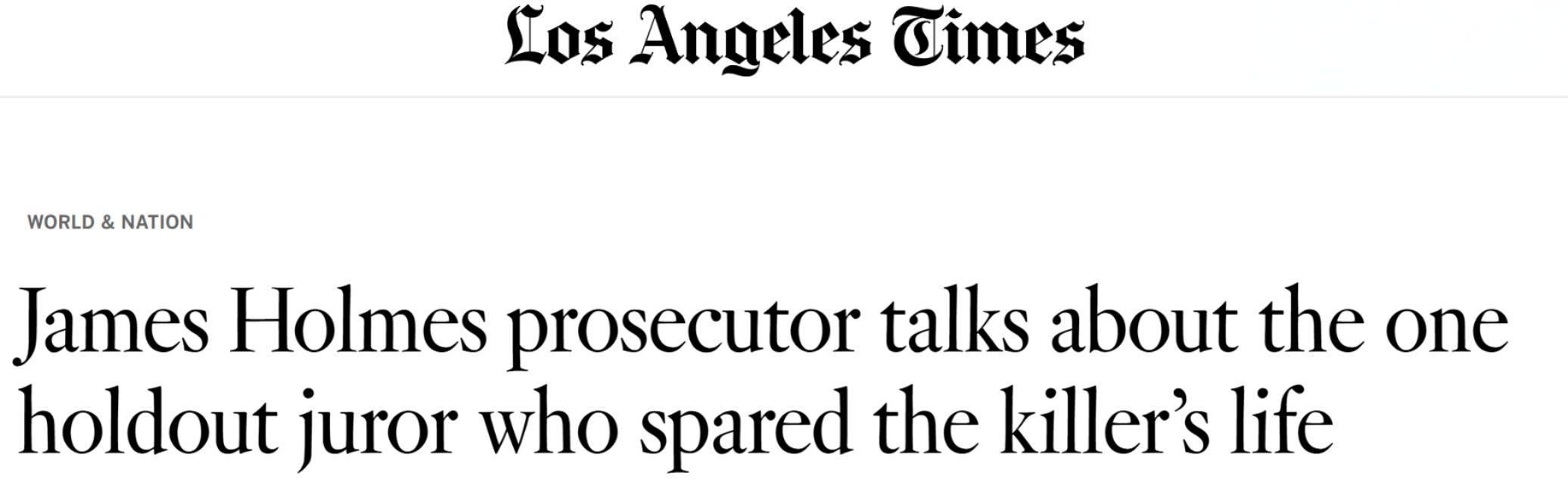
I put that headline about James Holmes up to to remind you that “mental illness doesn’t do that” has life-or-death stakes. If mental illness doesn’t do that, if we’re allowed to pick and choose what we’ll excuse when it comes to accommodating mental illness, then that juror who spared Holmes from the death penalty may as well have let the state strap him to a gurney. Once you’ve broken the seal on “mental illness doesn’t do that,” what special treatment is there left to give?
With West, the antisemitism is usually the straw that breaks the camel’s back. If this were only about washing your hands of him, declaring that you can no longer excuse his bad behavior, that wouldn’t be much of a problem, or at least, it wouldn’t be your problem. “I’m walking away from this person with mental illness even though I know their mental illness is contributing to the behaviors that are pushing me away” is a very common story, an ordinary one, and a justifiable one. My adult life has involved a steady procession of people I was once close to making that exact decision, and though I miss them I don’t blame them. But of course, that’s not what your average Twitter cretin is saying when they invoke West’s antisemitism as the last straw. They’re saying, instead, that West’s antisemitism proves that his problems are not related to his psychotic disorder.
Which, you know, is really something. The claim “People with mental illness don’t say antisemitic shit” is pretty wild; do you have the slightest idea how much antisemitism radiates out of the average psych ward? The CIA, the Freemasons, and the Jews are like the schizophrenic holy trinity. Does the fact that mentally ill people are very often guilty of engaging in personal bigotry excuse that personal bigotry? No. Not if you don’t want it to. It’s all very complicated, you see, but you can make your personal rules about who you associate with (or whose music you listen to) as simply as you’d like. Nobody is telling you that you have to like Kanye West. But when you say that you have a political and moral obligation to the concept of disability accommodation, then you’re demanding the question of why West would not fall under the blanket of your obligation. This is a question of culpability that I’m afraid will remain anguished, and social media doesn’t do anguished, especially not when they have an excuse to scream about an -ism.
The beauty of ableism as the identity crime du jour is that disability is so capacious and vague a concept, in the 21st century, that anyone you please can fall under its protection and anyone you please can be left out. Ableism is a remarkably malleable idea; once upon a time, people understood that the downside of not being able to walk was not being able to walk, not some vague and formless insult to your personal dignity. But that’s the whole advantage of the idea, that capacious formlessness, which means you can bend ableism into whatever shape you want. And people do, so that we’re left in a world where questioning a 22-year-old’s convenient ADHD self-diagnosis right before LSAT season is ableist but unpersoning a guy with a psychotic disorder for acting like a guy with a psychotic disorder isn’t. Digital distance, meanwhile, enables selective sympathy. It doesn’t matter how many crazies mutter about the Jews in psych wards because psych wards are filled with actual patients while “ableism” is a condition that only ever hurts abstractions.
If the rule instead really was “forgive Kanye West, for everything, because he is sick,” that would be comforting because simple is always comforting with moral questions. But we are not blessed with such a scenario. We are instead caught in this permanently unresolved space: what is him, and what is his disorder? Did the serious head injury he suffered as a young man cause later personal instability, in a way that has been documented many times with traumatic brain injuries? Does the timeline suggest that the death of his mother sent him into this spiral? Once you start asking such questions, it’s hard to stop. But we’re still beings who ultimately must judge. And it’s not comfortable to consider that we might reject someone who is bad because they’re sick or forgive someone who’s just bad. As is my habit, my intent is to force you to live in that unhappy space, which is exactly what the “mental illness doesn’t do that” crowd is trying like hell to avoid.
Of course when I write about Kanye West, I’m also writing about myself. You might assume that I’m therefore looking for exoneration for all my sins on the grounds that I too am sick. And it’s true, I am sick. This fact has become rather abstracted over the years, which is my own fault, but I do in fact have a serious mental illness and though I have smothered it in drugs and therapy it does not go away and sometimes it comes bubbling back up through all the treatment and I have to force it back down at the most inconvenient of times. But I don’t ask for exoneration. I ask only for honesty about the existence of my disorder and the plain fact that any rational moral evaluation of my behavior would include its existence. And, as I’ve said many times, I hope that it might mitigate your judgement - not excuse anything, but to enter into your thinking, to be weighed and balanced, to influence your decisions. If you do that, honestly and with an open mind, I can’t complain even if you still end up deciding that I’m a scoundrel. It doesn’t seem that unreasonable given what people say they believe about disability. And yet….
You might look at my admirers out there, the Bluesky types, the typical radlib media denizens with whom I’ve had friction for a long time. These are the exact sort of people to use the term “ableist” and to think of themselves as passionate friends of those with disabilities. But I am one of those with a disability, and none of them have ever extended the slightest accommodation to me. Most of them refuse ever to acknowledge my bipolar disorder, which is funny because many of them have been calling me unstable or crazy for longer than I’ve been public about my condition. They’re certainly aware of it. But they’ll routinely bring up my awful treatment of Malcolm Harris and use it to justify their regular efforts to keep me from having a career without once noting that I was psychotic when that happened. I’ve said over and over again that I don’t think that what I did to Harris should be absolved or excused because of my mental state. Certainly the deep guilt I still carry, towards him and others, would indicate that I have not excused myself. I have asked that my disorder be considered, kept in mind. It might be worth acknowledging that, whatever else is true about me, I’ve never done something like that before or since, or you might be moved by the basic logic that I had absolutely nothing to gain from doing it and the total destruction of my professional and personal life that followed was totally predictable. You might.
Ultimately, that question stopped being particularly salient for me awhile back. Accommodation provided or no, I did my time and I have moved on, and the people who still try to obstruct my efforts to move forward are never going to change their mind. I did something really bad, I faced immense personal cost for it, I apologized a hundred times, I completely changed my life, and it’s been eight years. And, yes, the influence of a disorder I couldn’t control is relevant to the question of my culpability. None of which prevents you from still declaring me a villain. Go ahead; it’s everybody’s right. But what I won’t allow is for people to coast by the conflict between their stated politics around disability and the way they always end up exonerating people they like and condemning people they don’t. The trouble of course is that no one in the cohort of people I’m talking about is ever going to be forced to acknowledge that I was sick when I did something legitimately awful. And, if somehow that tension was forced into view, someone in their network would come up with some disingenuous reason why they all have no responsibility to confront the difficult, messy reality of real mental illness, why they can just condemn without pause or conflict. I mean, that’s why you build a BlueSky, why you treat the media business as a cool party instead of as a calling in the first place - so that you can pretend these kinds of questions are never hard.
I’m afraid it only counts when it’s hard. Accommodation really only means anything if you’re exactly as willing to offer it to someone you really don’t like as you are to someone you really do. This isn’t complicated. If you believe in the concept of reasonable accommodation, then you need to include people with disorders that prompt genuinely ugly behaviors. Otherwise it means nothing. Otherwise you’re left with the condition we have today, where all these bleeding heart friends of the disabled are always willing to offer accommodation to people with the social contagion of the month but who scorn those whose conditions are genuinely ugly, as is true of most people with real mental illness. Personally, I have done genuinely bad things under the influence of my disorder, more than you know, and most everyone with a psychotic disorder has a long list of true regrets. If you won’t accommodate actually ugly shit, in whatever way your conscience tells you to, then you won’t accommodate us at all. And if that’s true you should at least know that about yourself. If that’s true you should stop pretending to care about “ableism.” No one is impressed that you’ll forgive mental illness that represents itself as adorable little personality quirks. Because, obviously, there’s nothing to forgive there at all.
People tend to see pieces like this as some sneaky attempt to evade responsibility, some wily scheme I’m launching to get off scot-free. But you don’t need to worry. My condition itself has ruined my life for a quarter-century, and even as I’ve been so fortunate in my attempt to rebuild, every day it hurts, all before we even get to the refracted social costs and what might be accommodated. The odds, I’m afraid, is that someday my condition will try its hardest to ruin my life again. And for the record I hate doing this shit, hate talking about it, I really and truly do, because it makes it look like I need something from the people whose approval I could never want. It just so happens that I genuinely think my story is relevant to a big ugly mistake our elites are making in how they think about disability, and about bad behavior, and about judgment. So I write this with purpose but in a state of humiliation. You see, this is all hard for me too.