


Please Don't Let Political Contrarianism Turn You Into a Lunatic
don't have an anti-politics

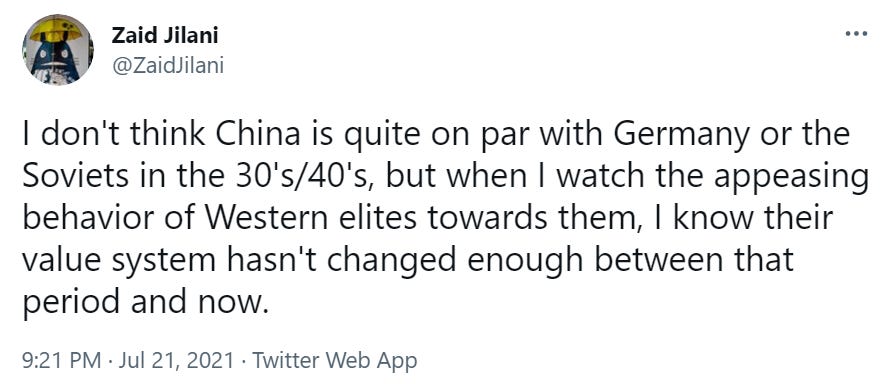
For you younger readers, Zaid Jilani’s rather fanciful tweet here is part of a neoconservative tradition that was inescapable for at least a decade after 9/11. In this particular little political meme, every year is 1938, every political leader is Neville Chamberlain, and every enemy is the Nazis. Jilani is complaining about “appeasement,” which is a bit of ideology that is predicated on the idea that bad actors do bad acts in the world not because this is an inherent element of history and humanity but because great powers - excuse me, “the West” - decide to allow them to. Jilani thinks that like the Nazis and, uh, the USSR before them, the Chinese government are being appeased by the United States/NATO/the UN/the aforementioned “West” rather than confronted for their bad deeds.
As Jilani’s tweet almost acknowledges, comparing 2021 China to the Nazi regime is, well, the kind of juvenile attention-seeking that I generally associate with the social liberals Jilani has such little respect for. China has some expansionistic tendencies, particularly in the South China Sea, and they explicitly have designs on Hong Kong and Taiwan. A country that rules both Maine and Guam has limited credibility in regards to opposing expansionism, but I agree that the people of Hong Kong and Taiwan seem to oppose Chinese domination and I support their democratic preferences. The true reality of Chinese crimes against the Uyghurs is almost impossible to understand from within Western media - there’s no doubt that the situation is a horrible crime against humanity, and also no doubt that essentially all Western media is dedicated to exaggerating anything bad done by America’s antagonists, so it’s hard to say. But sure, there are huge human rights violations in China. But at one point the Nazis literally militarily occupied territory from Scandinavia to the northernmost tips of sub-Saharan Africa, from the Atlantic Ocean to the Black Sea. Discuss the Axis Powers collectively and we’re talking from the Marshall Islands to Brest. Not only has China not accomplished any such thing, there probably isn’t a single figure in CCP leadership so deluded as to desire such a thing.
Then there’s, you know, the Holocaust.
I too wish that the other European powers had begun active military hostilities against Nazi Germany sooner. Neville Chamberlain’s miscalculation about Hitler and his ambitions cost a lot of lives. But, for one thing, there was no scenario where opposing Hitler did not result in an absolutely massive military conflict with huge casualties and civilian losses. And perhaps earlier opposition simply accelerates and intensifies German Jew-extermination efforts. My point is not that there shouldn’t have been earlier and more concerted efforts to fight the Nazis and their ambitions. My point is that even in the fanciful world of counterfactual history we should recognize that there was no scenario in which post-Versailles Germany did not end up causing immense human costs. Because history is a brutal place, even when we make it up.
But what’s truly bonkers here is Jilani’s invocation of the USSR. Even in the heyday of Paul Wolfowitz, when everyone called everything appeasement, most people didn’t go around calling the USA’s old policy towards the Soviets appeasement, because that’s completely insane. The effort against the USSR in the Cold War was one of the greatest expenditures of blood and treasure the world has ever seen. I have searched and failed to find a link, but I once read a historian make an estimate that at the height of the Cold War something like 18 cents out of every dollar the American government spent went to opposing the Russkies. The sheer amount of money we spent on opposing the interests of the USSR in the 1950s and 60s is simply staggering. And it’s not just military and espionage spending, either; the Cold War seeped into everything we were. I’ve written before about the fact that some of our university system’s problems stem from the consequences of pouring immense amounts of government cash into that system to stay ahead of the Red Menace. We used all of our diplomatic and espionage power to oppose the USSR, of course. And while much of it wasn’t that of Americans, we also spent rivers of blood to keep the Russians in check. Take a vacation in Cambodia to get a sense of that. I am just baffled at what Jilani thinks the US and NATO should have done to fight Soviet communism that they didn’t do.
It’s true that we did not generally engage in open direct armed hostilities with the Russians with our own military, though in some of our 20th century imperial misadventures we more or less did at times, but then doing old school let’s-meet-at-a-battlefield combat with the Soviets would have led to global thermonuclear war. Does our unwillingness to risk that really amount, in Jilani’s eyes, to appeasing them? To a failure of will? I am not often in the habit of agreeing with the political and military leadership of Western elites of whatever era, but I will gladly praise them for not reducing the world to an unlivable post-apocalyptic hellscape because we had to prove a point to Kruschev. You would think this commitment, at least, would be bipartisan, the acceptance that it’s a good thing the Cold War never went hotter than it sometimes did. But apparently believing this is impermissible for the same reason as it’s impermissible to accept the fact that China will be a superpower for decades to come. It doesn’t show resolve, or whatever.
Well, you should accept that China is and will be a superpower because there is literally nothing the United States or NATO or the UN or the “international community” can do to stop that. Nothing. A long time ago Matt Yglesias coined the term “Green Lantern theory of foreign policy,” a reference to the fact that the ring the sorcerer gave to Green Lantern (or whatever) enabled him to do anything he wanted, provided he truly had the will to do it. And Yglesias’s point was that neocons and many others in American politics think the United States is the same, in that we’re only constrained by our will - and we aren’t. We are constrained by many, many realities we can’t change. I pointed out recently that our 2003 Iraq invasion had as an explicit war aim “keeping the peace,” and we sent 150,000 troops and spent trillions, and the peace was not remotely kept. We wanted that, we committed immense resources to it, and we didn’t do it because the world defies even the imperial ambitions of the United States. Because we can’t just snap our fingers and decide “the world will be this way.” I think a lot of people who have lived in the heart of American nationalist propaganda for so long, like Jilani, still quietly believe that American power is essentially impregnable despite living through the past several decades. The United States is slinking out of Afghanistan after 20 years. The usual suspects are decrying this as, more or less, appeasement towards the Taliban, not seeming to understand that the Taliban live there, and we don’t, and thus they will always ultimately have more say than we do and cannot be waited out. American will in Afghanistan was irrelevant, and if the goal is something as crude as keeping China from dominating East Asia, our will is going to prove to be irrelevant there as well.
China will be a world power with immense military, diplomatic, and economic influence for the rest of my life and yours. We can do things, primarily economically, that can hopefully help improve the human rights of people in mainland China, Hong Kong, Tibet, Taiwan, and elsewhere in China’s sphere of influence. But China dominating Hong Kong? There is literally nothing we can do to stop that; I know, because I can look at a map. (The United States dominates South America, and that’s a fucking continent.) America’s unipolar dominance is probably already dead, but if not it’s a terminal patient, and again there is nothing we can do to stop that. All of history tells us that unipolar power of the kind enjoyed by the United States the last several decades is simply not sustainable. This is not a question of the will. China’s size, population, geography, economic power, resource wealth, and historical situation means it will inevitably challenge American power. Even militarily. Yes, if China decided to invade a bunch of islands in the Pacific, they would eventually be crushed by American air and naval power. But if they invaded Mongolia, and the United States was foolish enough to send its army to fight them there? To simply assume we would win is foolish, even aside from the fact that China has at least enough nuclear capacity to turn Mongolia into Fury Road in retribution if they lost. This is the kind of adult reality we all have to face up to. Please, read a little Daniel Larison.
Zaid: if the United States is appeasing China, what would not appeasing them look like? Annexing Xinjiang? Throw up harsh economic sanctions on China and you destroy the world economy. Go to war and you destroy the world economy. Pray for a sudden and serious Chinese decline and, if it happens, it will destroy the world economy. If you’re angry about the way that great powers like China are empowered to violate human rights, first, get mad at your own country, one of the greatest enemies of human rights in world history. But second, you should recognize that China’s impunity is a product of capitalism and nationalism. Unfortunately to do so you’d have to give credit to the anti-capitalists and internationalists out there, and doing so might seem to align you with the people with unironic pronouns in their bios. Can’t have that.
Maybe eight months or so ago someone emailed me and asked if I’d like to contribute to a book called like The Post-Left Reader or something equally stupid. I don’t know if they every moved ahead with it. But I told the lady, first, I don’t have the slightest fucking idea what the “post-left” is and wouldn’t join it if I did. I’m a leftist. The fact that I am in conflict with many aspects of what some call “the left” today is immaterial to my actual political position, which has remained fairly static for my entire adulthood, and the whole “what happened to you man” ritual that wokies perform these days is about their discomfort and not anything to do with me. Plus I’m not a joiner in general. Plus I don’t write for free for books or other publications that people charge money for. Not anymore. What is the “post-left” to me? I am the left.
I hear a lot from people who consider themselves part of the broad American left-of-center who have become alienated by social justice politics. Almost every day. However many people you think are in the progressive anti-woke tendency, there are many more, as the professional and social costs of not being woke are now so high that the vast majority of people who oppose those politics are in hiding. Sometimes this is an expression of wanting to rescue socialism from identity politics; sometimes it’s horror at the fact that so many liberals have become (nominally) socialists. There’s tons of variation in this space. What I tell them universally, but especially the young ones, is this: you have to be for something before you’re anti-anything. Anti-woke is not a political project. It’s not a philosophy. It’s not a plan. It’s just an emotional reaction. And while that kind of emotional reaction is certainly understandable, it can’t be the basis of intelligent and effective opposition to the things the anti-wokies hate. That’s why my first book says almost nothing about social justice politics or wokeness or whatever - because I have bigger fish to fry. My positive vision comes first and if you want to be a political person I suggest you should feel the same.
This is all a small part of why I have types of IRL political engagement that I keep separate from anything I do online. Because you have to stay rooted in something that goes beyond people who annoy you on social media.
You don’t turn people away from a bad political tendency through the denial of that tendency but by making your own tendency more attractive. I agree with Zaid Jilani on many things and appreciate that he has so consistently made the case that crime matters, that it mostly hurts the poor and racial minorities, that Black voters clearly have serious anti-crime commitments, and that the left’s dedication to ignoring the issue is a political and moral failure. I admire that. But from reading his publication or his tweets I’m not remotely clear on what he stands for in general, rather than what he stands against. That might be a career path but it’s not a political project. This is what I keep telling these kids who are so motivated by anti-woke sentiment: if you aren’t something first before you’re anti-anything, you’ll wake up one day and you’ll find you’ve become completely unmoored.
I found Freddie's argument unconvincing. If you're an NBA coach, or a member of the US State Department, or a major tech company VP, you have to be very, very careful about saying something like Freddie's "But sure, there are huge human rights violations in China". Most such people are consciously careful not to say things like that, because they know it could damage or end their careers. That is literally appeasement. Collectively, it emboldens oppressors in the Chinese government. Within China, people are taken by the government from their families, and imprisoned or put in work camps, for saying things like this. What would you call the fealty that the Chinese government demands, even of foreigners, but a demand for appeasement?
As for "don't have an anti-politics"... oh, for fuck's sake, Freddie! You're the most anti person I've ever known with regard to your political positions and takes! It's often thought-provoking for me to read your fresh perspectives, but they are almost always a contrarian reaction to a mainstream view. Zaid didn't actually suggest that the West was appeasing to the USSR, but Freddie went on a whole rant about how "insane" that is anyway.
"you’ll wake up one day and you’ll find you’ve become completely unmoored", indeed!
You are, of course, correct that the United States was practicing no sort of "politics of appeasement" towards the Soviet Union in the Cold War. I don't believe many would argue that. But Jilani was referencing U.S. behavior towards them in the 30s and 40s, and if our behavior then wasn't appeasement, I'm not sure what one ought to call it. In specific, I would argue that the United States followed a pattern of appeasement towards the Soviet Union in the 1930s and 1940s despite irreconcilable ideological aims, leading ultimately and predictably to the Cold War. Several specific moments illustrate this reconciliation:
Most famous is Walter Duranty's receipt of a Pulitzer for romanticizing the Holodomor-era Soviet Union. Because it is so well-known, I will not dwell on it. Less remembered is that the United States elected to reverse its policy and officially recognize the Soviet Union at around the same time in 1933, accompanied by an empty pledge from the Soviet Union not to conspire for the overthrow of the American Government.
More interesting to me is the case of William Bullitt, our first ambassador to the Soviet Union, who started his tenure as ambassador with deep sympathies towards its aims and ended it by providing a scathing warning:
"The Soviet Union genuinely desires peace on all fronts at the present time but this peace is looked upon merely as a happy respite in which future wars may be prepared... It is of course the heartiest hope of the Soviet Government that the United States will become involved in a war with Japan. . . . To maintain peace for the present, to keep the nations of Europe divided, to foster enmity between Japan and the United States, and to gain blind devotion and obedience of the communists of all countries so they will act against their own governments at the behest of the Communist Pope in the Kremlin is the sum of Stalin's policy."
I'm not sure how to read Roosevelt's rejection of that warning and subsequent reassignment of Bullitt to France as anything but an example of appeasement.
The examples of appeasement continue apace through World War II. What bitter irony that Britain entered the war by pledging to defend Poland against the Nazis, and the Allies ended it by explaining to the erstwhile Polish government, at that point exiled in Britain, that they could do nothing for them and that their country would stay in the hands of the Soviet Union. What was the Tehran conference if not appeasement: the US and Britain sitting down at a table with Stalin, pledging to allow his annexation of the Baltic States and large parts of Finland and Poland, along with massive influence over eastern Europe?
Even moments like our action (or rather, lack thereof) in China could be viewed as appeasement: the US encouraging the Nationalists and Communists there towards an impossible peace, while the Soviet Union shrugged and provided Mao with all the military aid he needed to seize the whole country and exile the Nationalists until the present day.
You say the case for appeasement of the Nazis is stronger because by the height of the Cold War we may have been spending 18 cents out of every dollar to oppose the Soviet Union. But that is like saying there were no efforts to appease the Nazis because at the height of World War II, we completed such a comprehensive rout of them that they were swept from the earth and their ideology made synonymous with the height of evil. No, appeasement isn't what happened during the Cold War, but prior to it: During the same time the world had elected to use the greatest collection of military might ever assembled to make the Nazis a hiss and a byword, with full awareness of what the Soviet Union was and intended, we overtly helped its sphere of influence spread from Russia alone to 23 nations containing almost half a billion people by 1946.
Yes, after that point, the US entered a long, drawn-out ideological war against the Soviet Union full of bitter proxy wars, immense effort, and blunders along the way. But the Cold War didn't start until we spent the better part of two decades aiming towards appeasement, and pointing to what we did after that switch flipped is a poor case against calling our actions during the 1930s and 1940s appeasement. I believe, by any clear standard, they were.