
One Day, I Briefly Understood


When I was a teenager, I had an experience that was and has remained unique in my life. I was lying down, thinking deeply, when suddenly I knew something I had always known on a deeper and more profound level. Then it was gone.
I was lying at the foot of my father’s bed in my childhood home, pressing my head into a pillow and staring out the window. I must have been 14 years old, at the oldest, as we were soon to leave there and he was soon to leave us. I liked to lie there and think in that spot, which thanks to quirks of architecture and pressure gradient often resulted in the sound of whistling winds that could not be found in any other part of the property. There was a grand old oak tree in our backyard, the canopy of which defined the limits of human altitude in my childhood imagination, and I liked to think that the breeze came rolling over the fields that surrounded our house before wrapping around the oak and bouncing off the irregular stone patio floor my father had laid outside before I was born. When he was older and his cancer was sufficiently advanced he apparently lost the ability to make it across the house and up the stairs to our single bathroom; that was the conclusion I drew, anyway, from the fact that the stones outside his space had come to smell constantly of piss, an unusually vegetal urine smell. Trimethylamine, I take it. This is a considerably less romantic image than majestic oak trees that boundary the sky, but that smell is an indelible memory of a core transition in my youth, the beginning of the ending of the end. Anyhow: the wind still whistled, the piss smell did not penetrate inside, and his bed at least was sturdy, a testament to Dutch craftsmanship.
His room was a converted garage that connected to the house via a thin mudroom that also had stones for a floor, so that if you crossed outside you went from one set of tiled grey rocks to another; outside or in, the stones were invariably freezing cold on the feet. Up above his bed was an overhead loft space, which served as storage and as his secret space to escape to. There was no ladder, which was his anti-curious-sons mechanism; he was tall and could simply pull himself up into the loft from the bed, when healthy. When I grew tall enough to do the same it felt like a major milestone. I still didn’t go up there, though. It would have been a violation, to see his old overcomplicated wargames, costumes from his old productions, pictures of my mother. It had also probably been a violation when, about a year earlier, I had found one of his Ziplock weed bags and pulled out a bud, “smoking” it by simply holding a lighter flame up to it and waving it under my nose until I was authentically high. But he never noticed, was not in a condition to notice, and anyway that was lovely old hippie weed, giggle weed, pleasant afternoon high weed, not the brain-obliterating mental cyanide that the profit motive has foisted on us today. I never stole any of his weed again, mostly because that first time had taught me that weed was for sharing with friends.
One day I was lying there - I can’t remember if the wind was whistling that day, but I can’t imagine the scene without it - and I suddenly had a set of thoughts that I knew to be something special. I had been pondering the indifference of nature. This is a very freshman English theme, and so it’s possible that I was pulled in this direction by some assigned reading, Emerson or someone else I would likely never had read had I not been put up to it by a teacher. (Twenty-three years of formal schooling in my life and still I miss assigned reading.) At the root of it, what I was thinking was simple, even banal: nature is truly indifferent to mankind, operating entirely unconcerned with humans except in those rare moments when animals are killing us or those far more common moments when we’re killing them. We deform the environment in every imaginable way, and those deformations impact animal and plant life, but the animals and plants deal with each change individually and directly, with no overarching concept of the human, no sense that nature ever ends and the human begins; they lack our self-obsession. The crows will trade you money for food, if you train them, but the transaction for them is only in the finding of the bills, in the collection of the food. Animals are not possessed of the fixation on human beings that for us is so core to basic consciousness we barely think of it as a way of thinking at all. For them there is no human or natural world, only encounters in places, corporeal dirt and trees and water and rocks against which animal life labors to survive.
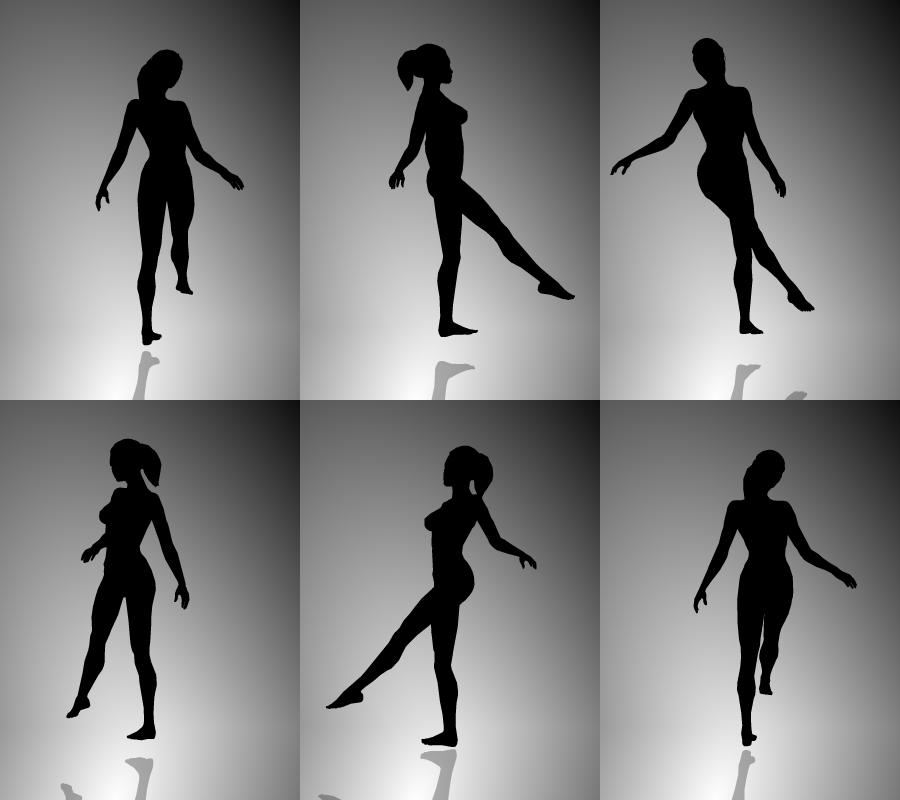
Like I said, not deep. But I lay there that day and I thought about it and I thought about it and I turned the thought around in my head a few times in a purposeless way and suddenly I had a purely cognitive feeling that I’d never experienced before: I grokked it. I experienced understanding that penetrated deeply enough that the line between what I knew and what I was had started to dissolve. I perceived the same basic idea but on a level that revealed the deepest truth of it, not through the accumulation of new information but through a more penetrating apprehension of the old. It’s not that I didn’t suddenly grasp new facets of the concept, didn’t have fresh insight - I immediately did - but rather that this was not a matter of acquisition but rather of assimilation. The transcendent understanding had always been there, sitting right there unhidden in the shallower and more prosaic form of understanding. I had simply turned the mental object around in my head until I achieved a revealing new perspective on it. It felt something like that gif where the dancer spins one way, one obvious and particular way, could only be spinning one way, such that the idea that she could be spinning the other way seems absurd to you, until suddenly she’s doing exactly that, reoriented so unceremoniously that you barely notice it’s happened. You had already seen all of her literal form; there was no new visual information to gain. Rather, you suddenly find you can separate the dancer from the dance.
I had known the indifference of nature before. In that moment I still knew it, but I also was it. Certainly that knowledge had become a part of me, and I will risk being a little New Agey in saying that maybe I had become part of it. The indifference of nature had become something more than thoughts and was instead something that insisted on itself in a quiet and unfussy way, like the pressure change in your ears while you slowly drive to a higher elevation. You could be forgiven for thinking that this was some sort of mystical experience, but in fact it was the opposite of mystical, thoroughly pragmatic, explainable, unsentimental. Experiencing it was life-altering but the experience itself was fundamentally mundane. Thinking of nothing else, unaware of time or my body, I rolled the understanding around in my mind, both the thought itself and the feeling of thinking it, and then after maybe an hour or so, it was gone.
I grew afraid that I would lose it as soon as I comprehended what was happening, but at the beginning the fear seemed irrational, somewhat childish; to forget what I had come to understand about the indifference of nature would have been like forgetting how bad alcohol can burn your throat, like forgetting your first bee sting. The intensity, yes. But also the simplicity - who could forget learning to draw a cube, fat elementary school pencil on thick elementary school paper? Not just the drawing of it but the understanding of its parts and how they work and why an inside corner has the same form as an outside corner, why projection and depression are simply points of view. Who could forget that? And yet, still, I was busily exploring what I newly understood, trying to think of how I could apply it to my advantage such that it might end my deep unhappiness, and then I realized it was gone. The feeling was not really a feeling, and I did not experience this understanding leaving my brain. This forgetting did not happen in present tense. Instead I remembered what I didn’t know, before I knew I didn’t know it. Coming around to that realization felt exactly like when you have to remember a long number and you have it and you have it and you have it and then it’s gone, not just an obscuring of that information but a perfect blank, an empty envelope. I didn’t panic. But I was deeply unhappy, annoyed, put off, thought about asking to see the manager, as what I had understood had seemed so logically emergent, such a plainly accessible product of ordinary stepwise human thinking that I could surely summon it on command. And then, somehow, I had forgotten the steps.
Put it this way: despite knowing how it works, despite experiencing it flip a thousand times, I sit here completely unable to make that delicate image of a dancer above spin in the direction of my choice, can’t force her to turn her pirouette en dehors into a pirouette en dedans. I understand why she turns. I understand why the dark nothing of her interior is essential to her ambiguity. I get it all. And I understand that reversing her spin is a reflex of the brain, not a choice of the mind, and in turn I must confront the possibility that my feeling that I had transcended understanding was itself merely a trick of neurology, a consequence of chemistry. But part of me insists that if only I could switch her back and forth, I would truly understand the way I once understood. When I try to make her switch, it always feels like I’m so close.
As a 14 year old, I felt a slippery sense of loss at having gotten my hands on this experience, on understanding something so deeply that it felt like a solid foundation I could rest against when I needed to. The indifference of nature was not and is not a matter of particular intellectual or emotional importance to me, and certainly if I had the chance to choose what to grok, I would not have chosen that. It would not have been on my own personal list of the top hundred things I’d like to grok, really. But we don’t choose a lot of our core developmental moments; I would not have expected the smell of piss to teach me that a man who I thought could never die was dying, but there it was. I’ve excavated the experiences of my youth in writing many times - some would say too many - and yet I have never really known how to talk about that calm and lonely hour that I understood. I don’t think I’ve ever told anyone about it. In part, I guess, I fear being accused of appearing to brag, though this worry is peculiar; the most insistent thought I’ve drawn from that moment, in the 30 years since, has been that if it’s possible to know something the way I knew something for that hour, I really don’t know anything at all. Or perhaps the real fear is the one that provokes everything I do: the fear of being unable to make myself understood.
When I forgot, when I no longer grokked the indifference of nature, I comforted myself that surely if such a thing had come to me at 14, a similar depth of understanding would come again; I had nothing but time. The world lay ahead, if only I could survive long enough to experience it. When I was merely thinking in the ordinary human way, just spending quiet time thinking, perhaps straining to hear the wind, the experience would replicate itself and I would grok other things, maybe grander things, maybe more practical, maybe things I could use to drag myself to the vague creative glories I dreamed of but could not define. Maybe I could even finally truly know “all those I loved and did not understand.” I was confident, and I was willing to be patient, and I knew I would recognize the feeling again immediately. Resolved, I set out to wait for a time when I would again understand deeply enough to know something beyond knowing, to have understanding be a part of me, to grok. I never have.
What you describe reminds me of Camus' _The Stranger_: "I opened my heart to the benign indifference of the universe..."
I think I've experienced what you've experienced, or something similar to it. It liberates you, momentarily, from the constant judgement that constitutes the universe of a self-aware person. We live our lives seeing everything as good or bad in relation to ourselves (includes ourselves) . . . and then suddenly all that is illusory, irrelevant. I wouldn't call it comforting, but it is . . . spacious.
I can especially relate to that frustration of irreproducibility. Gurus strain in vain to reproduce in themselves and others an insight that was spontaneous and immune to causality.
I had a similar experience, one time, in graduate school, walking home at night, close to 20 years ago. It lasted from my packing up at the library, the entire walk home, and briefly in my tiny apartment, before fading, and then it was gone, and it was back to the mundane. Transcendent is the obvious word to reach for. I do not remember in particular where this feeling of understanding came from because I fail to remember a single "object" or concept or anything else, I understood. But it was undoubtedly a feeling of understanding. Looking back, I am tempted to dismiss it as a mixture arrogance, longing, loneliness, and the chemicals lining up in such a way that I felt different that one time. But I think that's unfair to my 22 year old self.
I've had other transcendent experiences, particularly with the my two children, when they were born, as they grow, but of a different flavor. Or when running on fumes trying to finish a marathon in a city I had memories in when I was younger (there, it is more clearly caused by chemicals). I couldn't tell you whether these experiences are different in kind or degree, but I learn toward "in kind," but don't make me justify it.
It's tempting to reach for this or that concept to make sense of it. To evoke "phenomenology" or whatever.
What I am confident of is that it did seem to "matter." I couldn't document how other than it provided some near-term fuel to keep going. But it mattered, and the feeling returns in meta form, thinking about the feeling, like when writing this comment.